

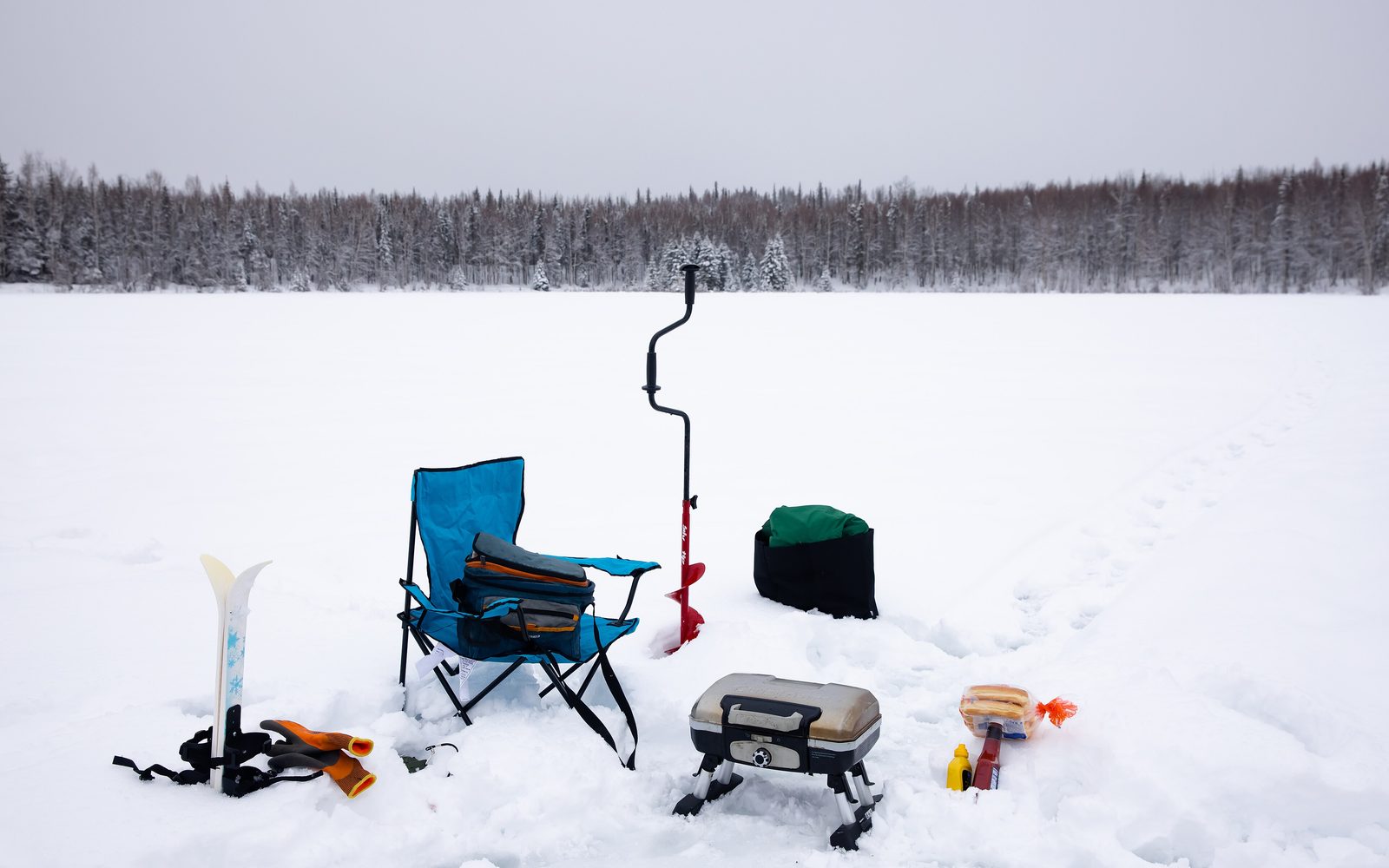
Agencies set 4 inches of clear, solid ice as the minimum for walking out. Read ice thickness safety before you drill.
Where crappie are in winter
New York says crappie may be found along weed edges or suspended in the water column, from a few feet under the ice to within inches of the bottom. Oklahoma describes them suspending over brush piles and other structure in deep water during the cold months, and notes that “deep” is relative to the body of water.
Which depth to start at
The agencies don’t agree, so try both and let the bite decide:
- Start high. New York’s crappie page says it pays to start jigging just under the ice and work down.
- Start low. New York’s ice-fishing guide says to start jigging near the bottom with small minnows or small jigs tipped with spikes, and if no fish are found to jig at different depths.
- Narrow band. Wisconsin says bluegills and crappie often hold in a narrow band within the depth range, so once you find the depth, stay in it.
Iowa adds that crappie often move up from beneath to take a lure, so many anglers hang the jig from a small bobber. When a bobber is used, Iowa says to fish the jig at least a foot off the bottom.
After dark
New York says crappie fishing can be very good after dark, and Iowa says crappie often feed after sunset, which makes the hours after sunset a good time to catch them.
Jigs, hooks and line
| Item | What agencies say |
|---|---|
| Jig head weight | 1/32–1/8 oz works in most situations (NY); Iowa’s most popular lead-heads run from 1/80 oz up to no more than 1/16 oz; Missouri names 1/64-oz jigs for panfish |
| Bait hook | Gold Aberdeen hooks in sizes 4–8 (NY); Iowa uses a size 4, 6 or 8 hook with a light split shot about a foot above it |
| Ice jigs | Keep tackle to scale with the fish’s mouth, such as a #12 (Wisconsin) |
| Line | NY ice table 4–6 lb; NY crappie page 4–8 lb mono; Iowa 2–4 lb, not to exceed 6 lb; Wisconsin 2–4 lb mono |
| Rod | Ultra-light jigging rod (NY ice table) |
New York calls small jigs the most-used crappie lure because they come in a huge variety of colors and styles.
Bait
Small minnows are the best live bait for crappie, according to Iowa. New York says to jig with small minnows or small jigs tipped with spikes.
Light bites and soft mouths
Crappie are called papermouths for a reason: Iowa says using too much force to set the hook can tear the soft membrane near the jaw and lose the fish, and New York says to keep the line tight once a crappie is hooked. A spring bobber, a thin steel wire clipped to the rod tip, shows bites before you feel them (Iowa), and Wisconsin says to keep floats and spring bobbers sensitive.
Hole hopping and noise
Wisconsin’s tips for panfish: if fish aren’t biting, move and see whether others are having success; be quiet, because it’s often the quiet, focused anglers who fill their pails; and drill extra holes when you first arrive so you can maximize the area when the bite gets hot.
Montana FWP says yellow perch and crappie are the species most likely to be caught while ice fishing with maggots and worms on small jigs just off the bottom. For the other panfish staple, see ice fishing for perch, and for the full starter setup, ice fishing for beginners.
To tell black from white crappie and see when they bite in open water, read the crappie species guide.
Sources
- Fishing for crappie, New York State DEC
- Panfish, New York State DEC
- Bluegill ice fishing tips (PDF), Wisconsin DNR
- Ice fishing (learn-to-fish guide, PDF), New York State DEC
- Ice fishing (I FISH NY lesson plan, PDF), New York State DEC
- Ice fishing, Montana Fish, Wildlife & Parks
- Ice fishing, Missouri Department of Conservation
- Ice fishing, Iowa DNR
- Crappie, Iowa DNR
- Winter fishing tips, Oklahoma Department of Wildlife Conservation