

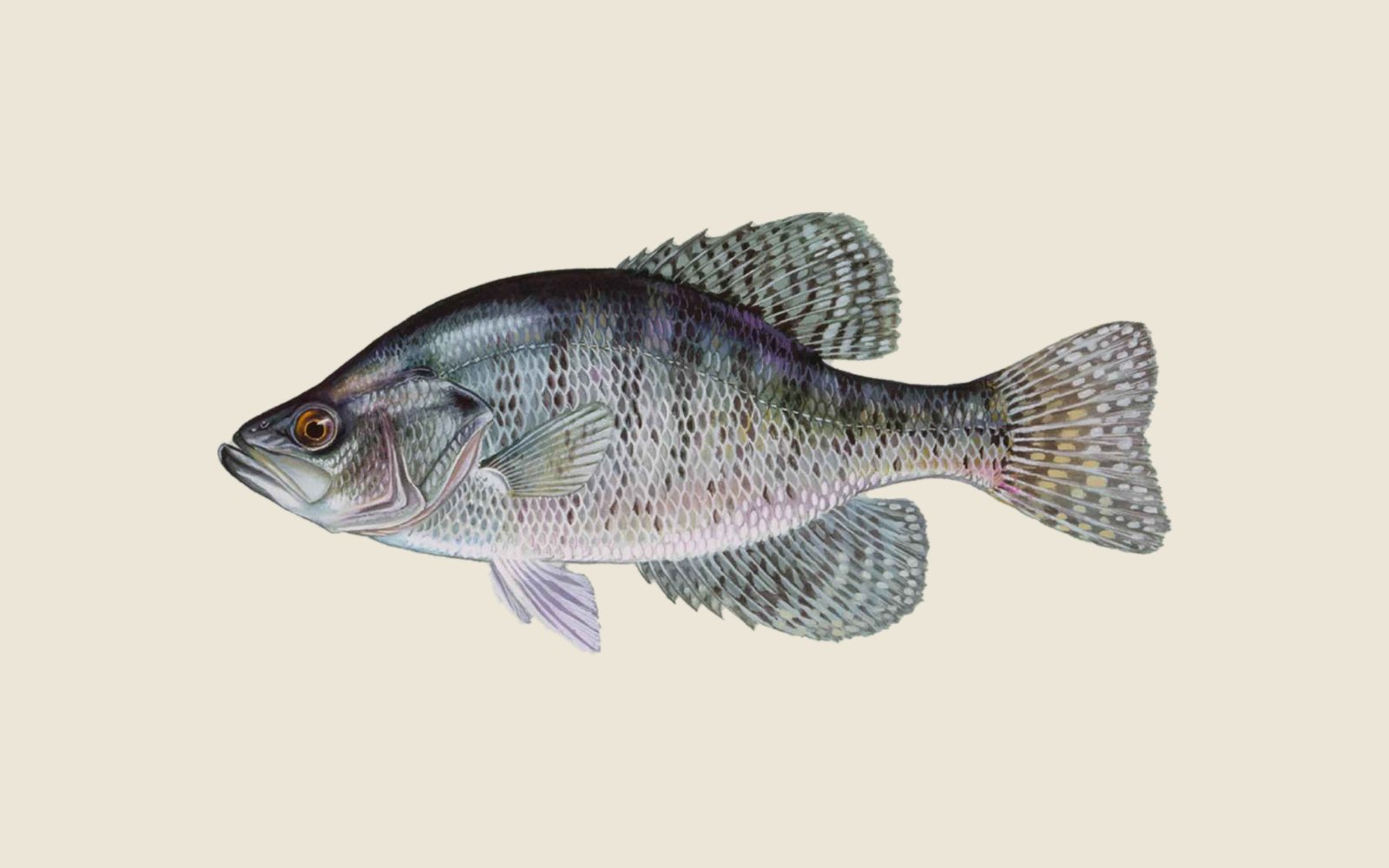
Crappie (black and white)
- Typical size
- 9–10 in; black seldom over 14 in, white seldom over 15 in
- Water temp
- Spawn at 55–68 °F, depending on state
- Best months
- Oklahoma: Mar–May · Missouri: mid-Mar (south) to end of May (north) · Wisconsin: May–Jun
- Top baits
- Small minnows, Grass shrimp (Florida), Jigs, usually 1/32–1/16 oz (Virginia, Missouri)
- Rig
- Float or jig, size 4–8 hook with light split shot (Iowa)
- Line (lb test)
- 2–4 lb (Iowa); 4–8 lb (Virginia)
Seasons, size and bag limits and licenses vary by state and water. Missouri Department of Conservation fishing rules
Black crappie vs white crappie: how to tell them apart
The two species look alike at a glance. The markings and the dorsal spines separate them, and the spine count is the quickest check on a fish in the hand.
| Feature | Black crappie | White crappie |
|---|---|---|
| Markings | Irregular speckles or blotches (Missouri) | Silver with 5 to 10 faint, regular vertical bars (Missouri); usually 7 to 9 (Iowa) |
| Dorsal spines | 7 or 8 (Missouri, Oklahoma, Washington) | 5 or 6 (Oklahoma, Washington); usually 6 (Missouri) |
| Dorsal fin base | Longer (Washington) | Shorter (Washington) |
| Turbid water | Less tolerant (Missouri) | Tolerates it better (Missouri, Iowa) |
| Diet | More insects and crustaceans, fewer fish (Texas) | Mainly small fish such as minnows and young shad, plus insects and small crustaceans (Missouri) |
| Typical size | 9 to 10 in, seldom over 14 in, to about 4 lb (Missouri) | 9 to 10 in, about 2 lb, seldom over 15 in or 4 lb (Missouri) |
Do not lean on colour alone. Virginia DWR says black crappie males can turn nearly solid black while spawning, while Texas Parks and Wildlife says Texas black crappie males show no special breeding colour. Florida has black crappie only, so the question does not come up there.
Where crappie live
White crappie hold in open water near submerged timber and cover in ponds, lakes, reservoirs and slow river backwaters (Missouri). Both species hold on structure: pilings, stumps, snags, rocks and the mouths of feeder streams (Washington).
Their depth follows the season. Oklahoma points anglers to shallow cover from spring through fall, such as coves, marinas, creek arms and grass flats, and to standing timber and brush. In cold months the fish sit deeper next to transition zones, on structure or suspended. Missouri boils it down to a rule of thumb: shallow in spring and fall, deep in summer and winter.
When to catch crappie: spawn timing by state
Pre-spawn movement starts early. Virginia DWR puts it at the upper 40s to low 50s °F, and Oklahoma at 45 to 55 °F. Virginia fish stage near spawning areas in mid to late March.
| State | J | F | M | A | M | J | J | A | S | O | N | D |
|---|---|---|---|---|---|---|---|---|---|---|---|---|
| Oklahoma | Not in season: January | Not in season: February | In season: March | In season: April | In season: May | Not in season: June | Not in season: July | Not in season: August | Not in season: September | Not in season: October | Not in season: November | Not in season: December |
| Missouri | Not in season: January | Not in season: February | In season: March | In season: April | In season: May | In season: June | Not in season: July | Not in season: August | Not in season: September | Not in season: October | Not in season: November | Not in season: December |
| Iowa (white crappie) | Not in season: January | Not in season: February | Not in season: March | In season: April | In season: May | Not in season: June | Not in season: July | Not in season: August | Not in season: September | Not in season: October | Not in season: November | Not in season: December |
| Wisconsin | Not in season: January | Not in season: February | Not in season: March | Not in season: April | In season: May | In season: June | In season: July | Not in season: August | Not in season: September | Not in season: October | Not in season: November | Not in season: December |
| Virginia | Not in season: January | Not in season: February | In season: March | In season: April | In season: May | In season: June | Not in season: July | Not in season: August | Not in season: September | Not in season: October | Not in season: November | Not in season: December |
Spawn temperatures differ by source: about 55 to 56 °F in Missouri, approaching 55 °F in Washington, 55 to 65 °F in Oklahoma, about 60 °F for Texas black crappie, 58 to 64 °F for Iowa black crappie and 64 to 68 °F for Wisconsin black crappie. Nest depth runs from 1 to 2 feet in muddy water to over 20 feet in clear water (Missouri), and Iowa black crappie nests are usually 3 to 8 feet down.
Crappie keep feeding after the spawn and can be caught all year, even through the ice (Missouri). Seasonal notes from the agencies:
- Summer: Missouri anglers fish at night in July and August, and summer nights are good in Florida. Washington reports a summer lull.
- Fall: Missouri crappie turn aggressive in October and November around docks in the upper 10 feet of water, and Washington says the bite improves.
- Winter: Missouri says crappie will not chase fast lures in cold water, so retrieve slowly.
- Time of day: Missouri says crappie are most active in the evening and night. Florida points to early morning and evening, and New York notes their large eyes help them feed in low light and after dark.
How to catch crappie
Live bait
Small minnows are the best live bait, according to Iowa DNR. Iowa suggests a 1 to 1.5 inch minnow hooked through the back below the dorsal fin, on a size 4, 6 or 8 hook with light split shot about a foot above. Virginia DWR fishes a lip-hooked 1.5 to 2.5 inch minnow under a float at 6 to 10 feet or deeper. Florida names small minnows or grass shrimp on a light-wire #4 hook with split shot below a float, drifted over deeper water. In Missouri summers, a small shiner or fathead minnow on a light-wire hook and split shot goes into deep brush.
Jigs and lures
Iowa DNR calls the lead-head jig the most productive artificial, in weights from 1/80 to 1/16 ounce. Other agencies agree on small sizes: Virginia lists 1/64 to 1/8 ounce with 1/16 and 1/32 usually best, Florida 1/16 to 1/8 ounce, and Missouri a minimal kit of 1/32 to 1/4 ounce jigs with tube bodies in two or three colours.
- Body style: Washington finds small plastic tube jigs and curly-tail grubs most consistent. Virginia uses stubby short-tail bodies on cold days and twister tails when it is warm or cloudy.
- Colour: Iowa says white, yellow or chartreuse in stained water and blue or black in clear water. Oklahoma favours chartreuse, especially in dingy water. Florida lists white, yellow, pink and chartreuse.
- Tipping: Florida tips jigs with a live minnow, and Washington tips lures with bait when the water is below 55 °F.
- Spawn: Missouri flips a 1/32 to 1/16 ounce jig to the shoreline. Oklahoma lists tubes, swimbaits, curly-tail grubs, hair jigs, inline spinners and live minnows.
- After the spawn: Oklahoma uses small silver lipless and diving crankbaits and jerkbaits for open-water schools.
Presentation
Retrieve slowly (Washington) with a steady retrieve that bumps cover (Missouri). Oklahoma says to present the bait above the fish, and Iowa hangs a bobber-suspended jig at least a foot off the bottom. Use a gentle hook-set, because the crappie’s mouth is thin (Washington).
Rod and line
Iowa DNR recommends an ultra-light spinning or casting rod with 2 to 4 pound monofilament, and nothing above 6 pound. Virginia DWR suggests a light 6 to 7 foot spinning outfit with 4 to 8 pound line.
More lists: best crappie jigs and bait for crappie.
Crappie size and state records
Missouri puts typical crappie at 9 to 10 inches. Oklahoma gives an average of 0.5 to 1.5 pounds, Washington 7 to 9 inches on average with 9 to 15 inches in quality populations, Iowa 8 to 12 inches for black crappie, and Florida says fish up to 2 pounds are common. Virginia says black crappie can exceed 16 inches and 3 pounds.
State records: New York 4 pounds 1 ounce for black crappie and 4 pounds 7 ounces for white crappie, Florida 3.83 pounds from Lake Talquin, and Iowa 3 pounds 14 ounces and 18 inches from Three Mile Lake on June 5, 2013.
Rules
Limits vary by state. Check the fish and wildlife agency where you fish, for example the Missouri Department of Conservation or the Oklahoma Department of Wildlife Conservation.
Frequently asked questions
How can I tell a black crappie from a white crappie?
Count dorsal spines and read the pattern. Missouri, Oklahoma and Washington list 7 or 8 spines and irregular speckles for black crappie, and 5 or 6 spines with faint vertical bars for white crappie.
What size are crappie?
Missouri puts both species at 9 to 10 inches typically, with black crappie seldom over 14 inches and white crappie seldom over 15 inches. Oklahoma gives an average of 0.5 to 1.5 pounds.
What water temperature do crappie spawn at?
It depends on the state. Missouri gives about 55 to 56°F, Oklahoma 55 to 65°F, Texas about 60°F for black crappie and Wisconsin 64 to 68°F for black crappie.
What is the best live bait for crappie?
Small minnows. Iowa DNR calls them the best live bait, and Virginia DWR names small to medium minnows. Florida adds grass shrimp.
What line do you use for crappie?
Light line. Iowa DNR recommends 2 to 4 pound monofilament and not above 6 pounds. Virginia DWR suggests a light 6 to 7 foot spinning outfit with 4 to 8 pound line.
Sources
- White crappie field guide, Missouri Department of Conservation
- Black crappie field guide, Missouri Department of Conservation
- Crappie fishing tips, Missouri Department of Conservation
- Crappie angler guide: top tips and area highlights, Oklahoma Department of Wildlife Conservation
- Black crappie (Pomoxis nigromaculatus), Washington Department of Fish & Wildlife
- Crappie, Iowa DNR
- Black crappie, Wisconsin DNR
- Crappie, Florida Fish and Wildlife Conservation Commission
- Crappie, Texas Parks and Wildlife Department
- Four great tactics for spring crappie success, Virginia Department of Wildlife Resources
- Fishing for crappie, New York State DEC