

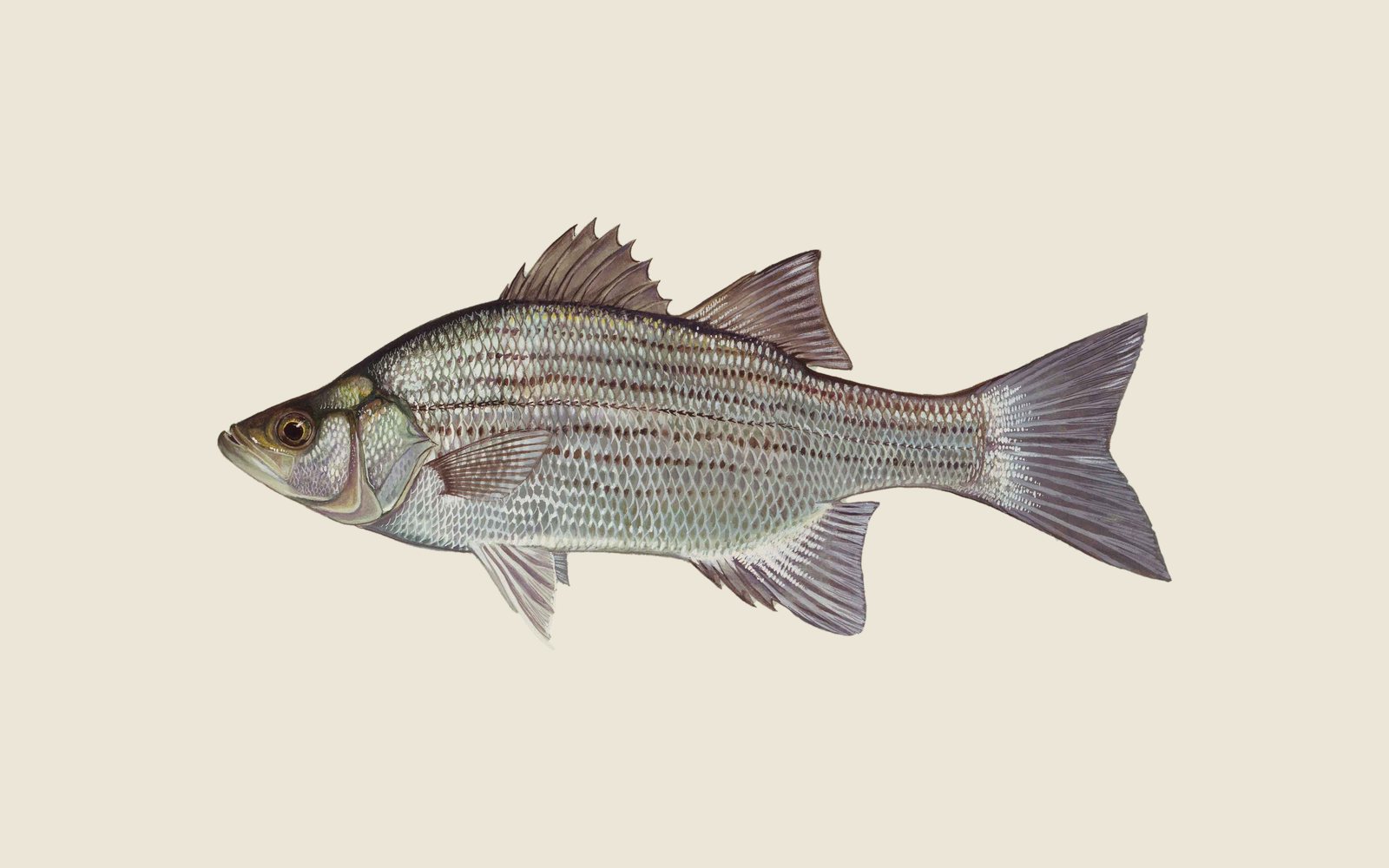
White bass
- Typical size
- 9–15 in, 1/4–1 1/4 lb (Missouri); seldom over 3.5 lb (Texas)
- Water temp
- Spawning run starts at 50 °F and peaks near 55 °F (Oklahoma)
- Best months
- Oklahoma: mid-Mar–early May · Texas: Feb–early May · Missouri: Mar–mid or late Apr
- Top baits
- Curly-tail grubs on 1/16 oz jigs, Inline spinners, Spoons and slabs, Live minnows
- Rig
- 12 in leader below a barrel swivel with a 1/4–1 oz egg weight (Oklahoma)
Seasons, size and bag limits and licenses vary by state and water. Check your state agency, for example the Texas Parks and Wildlife Department
How to identify a white bass
White bass are silvery and elongated with several dark horizontal streaks (Missouri). Iowa counts 5 to 7 longitudinal stripes, while Texas and Alabama describe several incomplete or faint lateral stripes. Oklahoma adds an arched back behind the head.
The tongue separates them from striped bass. A white bass has a single, heart-shaped tongue tooth patch (Missouri), and a striped bass has two (Oklahoma, Texas, Alabama). Striped bass are also not arched behind the head (Oklahoma).
Where white bass live
White bass are migratory open-water fish that chase shad (Oklahoma). Missouri finds them in deeper stream pools and open lakes over firm sand or rock, and Iowa in deep quiet river pools and mid-water in lakes and reservoirs. They avoid constant turbidity (Missouri). By day Oklahoma fish hold in open water, and at night they work sandy shoals.
Gizzard shad are the staple food (Missouri), and Texas says gizzard and threadfin shad are preferred. Oklahoma lists shad, minnows, crustaceans and insects. Spawning fish use gravel or rock in 2 to 8 feet of flowing water (Texas).
When to catch white bass: the spring run
The run is the main event. Fish concentrate at creek and river mouths, then move upstream. Males run about a month before females (Texas).
| State | J | F | M | A | M | J | J | A | S | O | N | D |
|---|---|---|---|---|---|---|---|---|---|---|---|---|
| Oklahoma | Not in season: January | Not in season: February | In season: March | In season: April | In season: May | Not in season: June | Not in season: July | Not in season: August | Not in season: September | Not in season: October | Not in season: November | Not in season: December |
| Texas | Not in season: January | In season: February | In season: March | In season: April | In season: May | Not in season: June | Not in season: July | Not in season: August | Not in season: September | Not in season: October | Not in season: November | Not in season: December |
| Missouri | Not in season: January | Not in season: February | In season: March | In season: April | Not in season: May | Not in season: June | Not in season: July | Not in season: August | Not in season: September | Not in season: October | Not in season: November | Not in season: December |
| Arkansas | Not in season: January | In season: February | In season: March | Not in season: April | Not in season: May | Not in season: June | Not in season: July | Not in season: August | Not in season: September | Not in season: October | Not in season: November | Not in season: December |
| Iowa | Not in season: January | Not in season: February | Not in season: March | In season: April | In season: May | In season: June | Not in season: July | Not in season: August | Not in season: September | Not in season: October | Not in season: November | Not in season: December |
Temperatures are the real trigger. Oklahoma says spawning begins at 50°F and peaks near 55°F. Arkansas says fish gather at stream mouths from 50°F and run upstream in the mid-50s. Texas gives 55 to 60°F with rain flow. Oklahoma anglers have a folk rule that the run starts when the redbuds bloom. Florida’s Ochlockonee River run is in late winter to early spring.
Spawning fish bite little, and Arkansas says they feed heavily before and after. Beyond the run, white bass feed most actively at dawn and dusk (Oklahoma), early morning and late evening near the surface (Missouri), and sometimes after dark (Iowa). Texas fishes under lights at night in late spring and summer. Look for gulls and surface disturbance, which mark shad schools (Oklahoma).
How to catch white bass
Lures
Oklahoma lists curly-tail grubs, baby shad, paddletail swimbaits, inline spinners, spoons, slabs, blades, lipless and diving crankbaits, jerkbaits and hair jigs in white, silver and chartreuse. It says to match the shad, usually 1 to 2 inches. In clear water use white or silver with dark backs, and in stained water chartreuse and red.
- Texas: jigs, spinners, soft plastic shad and small crankbaits. Colours are white, silver, pearl, chartreuse, yellow and metal-flake.
- Iowa: white or yellow 1/8 ounce jigs in tandem on surface-feeding schools.
- Arkansas: an angler’s kit of a 2 inch curly shad grub on a 1/16 ounce jig head, a 1/8 to 1/4 ounce white spinner with a silver blade and a small suspending jerkbait, all on light spinning tackle.
- Surface schools: Oklahoma uses walk-the-dog lures, propeller lures and poppers. Texas casts spoons or spinners to schools at the surface.
- Deep: Oklahoma vertical-jigs spoons or slabs on ledges, channel breaks and deep flats before the spawn and in summer.
Live bait
Oklahoma names a live worm, minnow or shad. Texas uses live or dead minnows and silversides, and fishes live bait on the bottom at night. Oklahoma’s simple rig is a 12 inch leader below a barrel swivel with a 1/4 to 1 ounce egg weight, and it calls the equipment “very basic.”
White bass size and records
Missouri lists 9 to 15 inches and 1/4 to 1 1/4 pounds, with a maximum around 5 pounds. Oklahoma averages 0.5 to 1.5 pounds, up to 5 pounds and rarely over 3.5 pounds, and Alabama gives 10 to 15 inches. In Texas a fish reaches 8 inches in its first year, and the state record is 5 pounds 9 ounces and 20.75 inches, set in 1977.
Rules
Limits vary by state and water. Check the agency where you fish, such as the Texas Parks and Wildlife Department or Oklahoma Department of Wildlife Conservation.
Frequently asked questions
How can I tell a white bass from a striped bass?
Check the tongue and the back. White bass have one tongue tooth patch and an arched back behind the head, and striped bass have two tongue patches and are not arched (Oklahoma, Texas, Alabama).
When do white bass run?
It depends on the state: mid-March to early May in Oklahoma, March to mid or late April in Missouri, and February to early May in Texas. Oklahoma says the best window is usually one to three weeks per water.
What water temperature triggers the white bass run?
Oklahoma says spawning begins at 50°F and peaks about 55°F. Arkansas says fish concentrate at stream mouths from 50°F and run upstream in the mid-50s, and Texas gives 55 to 60°F with rain flow.
What lures catch white bass?
Small shad-coloured lures: curly-tail grubs on 1/16 ounce jig heads, inline spinners, spoons, slabs and lipless crankbaits in white, silver and chartreuse. Match the shad, usually 1 to 2 inches (Oklahoma).
How big do white bass get?
Missouri says 9 to 15 inches and 1/4 to 1 1/4 pounds, with a maximum around 5 pounds. Texas says they are seldom over 3.5 pounds, and the Texas state record is 5 pounds 9 ounces.
Sources
- White bass field guide, Oklahoma Department of Wildlife Conservation
- White bass angler guide: top tips and area highlights, Oklahoma Department of Wildlife Conservation
- White bass field guide, Missouri Department of Conservation
- White bass, Iowa DNR
- White bass, Texas Parks and Wildlife Department
- White bass fishing brochure, Texas Parks and Wildlife Department
- White bass run news release, Texas Parks and Wildlife Department
- White bass, Outdoor Alabama (ADCNR)
- White bass run spawns action across Arkansas, Arkansas Game & Fish Commission
- Crappie, Florida Fish and Wildlife Conservation Commission