
Smallmouth bass
- Typical size
- 10–20 in, 1/2–4 lb (Missouri); 12–16 in average (Washington)
- Record (IGFA)
- 11 lb 15 oz, Dale Hollow Lake, 1955
- Water temp
- Spawn at about 60 °F (53–75 °F across sources)
- Best months
- Missouri: Apr–Jul, peak May · Wisconsin: mid-May–Jun · Lake Erie, NY: Apr–late Jun
- Top baits
- Crayfish and crayfish-pattern crankbaits, Tube jigs, Topwater poppers, Spinnerbaits
- Rig
- 3–4 in stickworm on a 1/8–1/4 oz jig head (New York)
- Line (lb test)
- 8–10 lb mono on a 6.5–7 ft medium spinning rod (New York)
Seasons, size and bag limits and licenses vary by state and water. Check your state agency, for example New York State DEC
How to identify a smallmouth bass
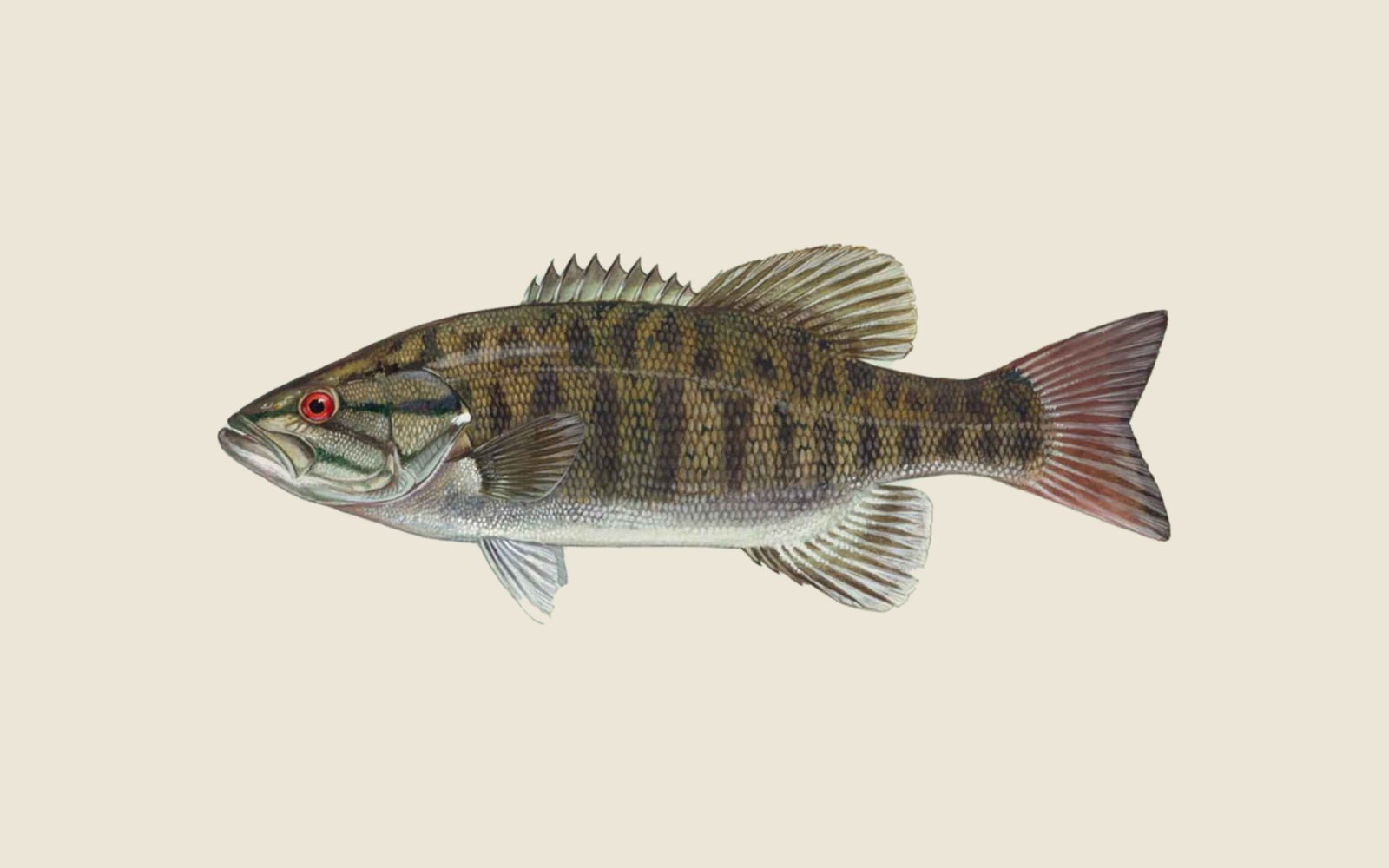
A smallmouth is green with dark vertical bands and no horizontal stripe (Texas). Washington describes it as mottled with dark vertical bars. The mouth is the dependable mark: the upper jaw never extends past the eye (Texas, New York), reaching only to about the rear margin of the eye (Missouri). In Oklahoma’s words, the smallmouth’s mouth hinge lines up in front of the back edge of the eye.
Missouri notes the two dorsal fins are connected, and Alabama counts 9 to 11 dorsal spines and 13 to 15 rays. For a full side-by-side with the largemouth, see smallmouth vs largemouth bass.
Where smallmouth bass live
Smallmouth want clear, clean, rocky water.
- Streams: Missouri finds them in clear streams with silt-free rock and gravel, near riffles but out of the main current. Virginia describes oxygenated, cool gravel-bottom streams and says the species is intolerant of siltation, warm water and pollutants.
- Lakes and reservoirs: Texas lists large clear lakes over 100 acres and over 30 feet deep. Oklahoma points to clear reservoirs with rocky bottoms, and Alabama to rock outcrops, logs, treetops and riprap.
- Depth: New York finds them around rocky areas in 5 to 35 feet of water.
Adults prefer fish, crayfish and frogs, and young fish eat small invertebrates (Virginia). Iowa found forage fish in 40 percent of stomachs, crayfish in 30 percent and insects in 20 percent, with crayfish over two-thirds where they are abundant. Washington calls signal crawfish the favourite food.
When to catch smallmouth bass
Spawning starts as the water nears 60°F, but the date shifts with the state.
| State | J | F | M | A | M | J | J | A | S | O | N | D |
|---|---|---|---|---|---|---|---|---|---|---|---|---|
| Missouri | Not in season: January | Not in season: February | Not in season: March | In season: April | Peak: May | In season: June | In season: July | Not in season: August | Not in season: September | Not in season: October | Not in season: November | Not in season: December |
| Alabama | Not in season: January | Not in season: February | Not in season: March | In season: April | In season: May | Not in season: June | Not in season: July | Not in season: August | Not in season: September | Not in season: October | Not in season: November | Not in season: December |
| Iowa | Not in season: January | Not in season: February | Not in season: March | Not in season: April | In season: May | Not in season: June | Not in season: July | Not in season: August | Not in season: September | Not in season: October | Not in season: November | Not in season: December |
| Wisconsin (southern) | Not in season: January | Not in season: February | Not in season: March | Not in season: April | In season: May | In season: June | Not in season: July | Not in season: August | Not in season: September | Not in season: October | Not in season: November | Not in season: December |
| Washington | Not in season: January | Not in season: February | Not in season: March | Not in season: April | In season: May | In season: June | Not in season: July | Not in season: August | Not in season: September | Not in season: October | Not in season: November | Not in season: December |
Spawn temperature sources also include Texas and Virginia (approaching or surpassing 60°F) and Oklahoma (60 to 75°F). Nests sit over gravel, about 2 to 4 feet deep in Virginia, 5 to 20 feet in Washington and 3 to 20 feet over Oklahoma gravel bars.
Best seasons
- Spring: Washington says fishing improves through spring and peaks at the spawn. New York’s Lake Erie fishery is best from April to late June.
- Summer: Washington reports a lull, though dawn and dusk can be very good, and fish rest below the thermocline in 20 to 30 feet by day. Wisconsin names June just after the spawn as the best lake fishing. New York says mid-June to the end of August at 60 to 75°F. Oklahoma says the best fishing is late spring through early fall, above 60°F.
- Fall: Washington says the bite improves, and Wisconsin names early fall.
- Winter: Virginia fish sit in winter holes in December and January and are lethargic from late December to February. If you go, fish from noon to about 4 p.m.
Oklahoma notes smallmouth stay under cover by day and prowl the shoreline in the morning and evening.
How to catch smallmouth bass
By season
- Early spring: crankbaits and suspending jerkbaits for lethargic fish (Washington).
- Spring: crankbaits, jerkbaits and spinnerbaits, plus grubs on a football jig and drop-shot finesse worms (Washington). On Lake Erie tributaries in April and May, New York names stickbaits, crankbaits and minnow imitations. On reefs in late May and June it lists tube jigs, twister tails, deep-diving stickbaits, spinnerbaits and crankbaits.
- Dawn and dusk: spinnerbaits, soft jerkbaits and poppers (Washington). Wisconsin says surface baits are probably the best artificials, and Oklahoma lists walk-the-dog lures, poppers, buzzbaits and frogs.
- Summer, deep: drag soft plastics or fish drop-shot finesse worms (Washington). In 20 to 40 feet on Lake Erie, New York uses jigging spoons, blade baits, spoonbill jerkbaits, tube jigs, soft plastics and live bait.
- Winter: a 3 to 4 inch swimbait on a 1/8 ounce jig head, slow-rolled, or tubes fished ned-rig style (Virginia).
Live bait
Wisconsin names hellgrammites, dragonfly larvae and crayfish in the early morning and late evening. Alabama fishes live bait or bounced jigs in the Wheeler tailwater.
Soft plastics and spinners
For Oklahoma streams, use 1.5 to 3 inch soft plastics on a 1/32 to 1/16 ounce jig head, with green pumpkin as a starting colour. Oklahoma also lists crankbaits and jerkbaits in shad, bluegill and crayfish patterns and 1/8 to 1/4 ounce inline spinners in green, brown, black or white. For big fish in deep holes it uses 3 to 5 inch soft plastics on 1/8 to 1/4 ounce jig heads. New York’s go-to in deep clear water around rocks is a 3 to 4 inch stickworm on a 1/8 to 1/4 ounce mushroom jig head. Iowa pairs light spinning gear with crayfish-coloured crankbaits. For more lure ideas, see best bass lures.
Rod and line
New York names a 6.5 to 7 foot medium spinning rod with 8 to 10 pound monofilament as its bass go-to, and Wisconsin simply says light tackle.
Size and the IGFA record
Missouri puts typical fish at 10 to 20 inches and half a pound to 4 pounds, with a maximum of about 22 inches and 6 pounds. Washington averages 12 to 16 inches, with 16 to 24 inches in quality populations. On Lake Erie most are 2 to 4 pounds and 5 to 6 pounds is possible (New York). Streams run smaller: Oklahoma’s Neosho and Ouachita strains rarely exceed 14 inches.
The IGFA all-tackle record is 11 pounds 15 ounces (5.41 kg), caught by David Hayes at Dale Hollow Lake on the Tennessee and Kentucky line on July 8, 1955. State records include New York’s 8 pounds 4 ounces from Lake Erie and Washington’s 8.75 pounds from the Columbia River on April 23, 1966.
Rules
Limits vary by state and water. Check your state agency before you fish, such as New York State DEC or the Washington Department of Fish & Wildlife. For month-by-month timing across bass species, see the best time to fish for bass.
Frequently asked questions
What is the world record smallmouth bass?
The IGFA all-tackle record is 11 pounds 15 ounces (5.41 kg), caught by David Hayes at Dale Hollow Lake on the Tennessee and Kentucky line on July 8, 1955.
How big do smallmouth bass get?
Missouri lists 10 to 20 inches and half a pound to 4 pounds as typical, with a maximum around 22 inches and 6 pounds. Iowa treats anything over 3 to 4 pounds as a trophy.
How can I tell a smallmouth from a largemouth?
Check the jaw. On a smallmouth the upper jaw does not extend past the eye, according to Texas and New York agencies, and Missouri says the two dorsal fins are connected.
What temperature do smallmouth bass spawn at?
Most agencies put it at about 60°F. Wisconsin says usually 62 to 64°F, seen as low as 53°F, and Oklahoma gives a range of 60 to 75°F.
What do smallmouth bass eat?
Adults eat fish, crayfish and large aquatic insects (Missouri). Oklahoma adds worms, frogs and tadpoles, and Washington says signal crawfish are a favourite.
Sources
- Smallmouth bass, Texas Parks and Wildlife Department
- Smallmouth bass (Micropterus dolomieu), Washington Department of Fish & Wildlife
- Smallmouth bass field guide, Missouri Department of Conservation
- Smallmouth bass, Outdoor Alabama (ADCNR)
- Smallmouth bass field guide, Oklahoma Department of Wildlife Conservation
- Smallmouth bass stream angler guide, Oklahoma Department of Wildlife Conservation
- Fishing for largemouth and smallmouth bass, New York State DEC
- Lake Erie smallmouth bass fishing, New York State DEC
- Smallmouth bass, Virginia Department of Wildlife Resources
- Fishing for smallmouth bass during the coldest months of the year, Virginia Department of Wildlife Resources
- Smallmouth bass, Iowa DNR
- Smallmouth bass, Wisconsin DNR
- Greatest records in sportfishing history, International Game Fish Association
- Smallmouth bass, Game Fish Database, International Game Fish Association