

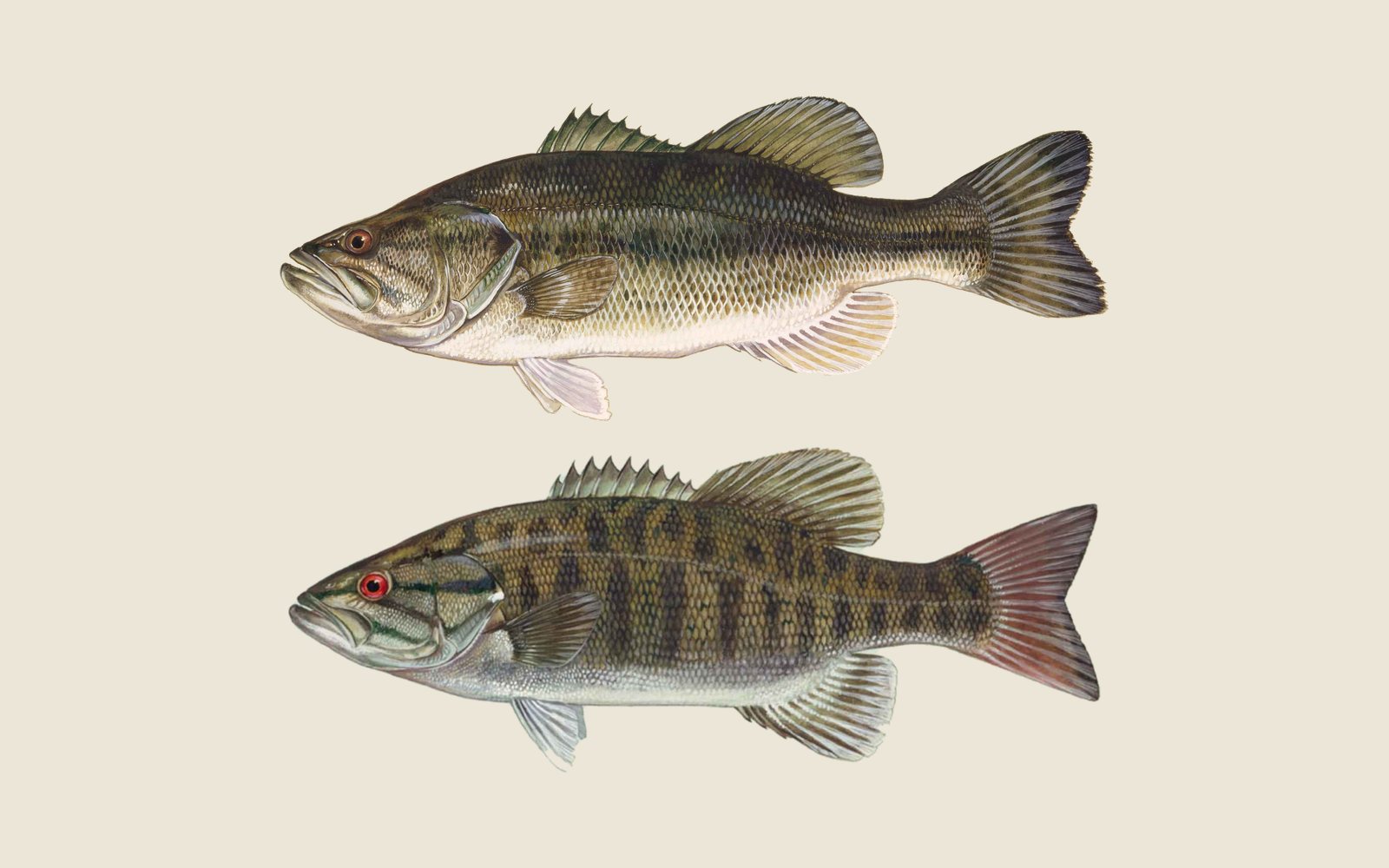
Smallmouth bass vs largemouth bass at a glance
Every row below comes from a state agency or IGFA. Where agencies disagree, the table shows the range and names the state.
| Feature | Largemouth bass | Smallmouth bass |
|---|---|---|
| Upper jaw | Reaches far beyond the rear margin of the eye (Texas, Missouri); hinge lines up behind the back edge of the eye (Oklahoma) | Stops at about the rear margin of the eye (Missouri) and never extends past it (Texas, New York); hinge lines up in front of the back edge (Oklahoma) |
| Side markings | Horizontal stripe of dark blotches (Texas); broad, continuous dark midside stripe (Missouri) | Dark vertical bands or bars, no horizontal stripe (Texas, Washington) |
| Dorsal fin | Almost completely split by a deep notch (Iowa) | Two parts connected, continuous (Washington, Missouri) |
| Young fish tail | Two-coloured (Iowa) | Three-coloured (Iowa) |
| Habitat | Shallow weedy areas and cover such as downed trees (New York); warm, moderately clear water with little or no current (Missouri); tolerates turbidity and slack water better (Alabama) | Rocky areas at 5 to 35 feet (New York); clear, gravel-bottom streams (Oklahoma); intolerant of silt, warm water and pollutants (Virginia) |
| Nest | Normally 1.5 to 3 feet deep (Iowa), in quieter, more vegetated water (Texas) | Near shore, downstream of a boulder or other obstruction (Iowa) |
| Spawn temperature | About 60°F in Texas; 62 to 65°F in Oklahoma; 63 to 68°F in Alabama and Iowa; about 65°F in Indiana | About 60°F in Texas, Missouri, Virginia, Iowa and Washington; 59 to 63°F in Alabama; 62 to 64°F in Wisconsin |
| Typical size | 10 to 20 in, 0.5 to 4.5 lb; maximum about 24 in and 15 lb (Missouri) | 10 to 20 in, 1/2 to 4 lb; maximum about 22 in and 6 lb (Missouri) |
| IGFA all-tackle record | 22 lb 4 oz (10.12 kg) | 11 lb 15 oz (5.41 kg), Dale Hollow Lake, July 8, 1955 |
| Reputation (New York DEC) | Eats nearly anything it can fit in its mouth | Among the hardest-fighting freshwater fish |
How to tell a largemouth from a smallmouth
Start with the mouth. Oklahoma calls the relationship between the eye and the mouth hinge the most objective test, and Missouri describes the same thing: a smallmouth’s jaw ends about at the rear margin of the eye, while a largemouth’s runs far behind it. New York puts it as a simple pair: a horizontal band and a jaw past the eye mean largemouth, and a jaw that does not pass the eye means smallmouth.
Then check the fins and sides.
- Dorsal fin. A largemouth’s dorsal fin is almost split in two by a deep notch (Iowa). A smallmouth’s fin parts are continuous (Washington).
- Side pattern. Largemouth carry a broad dark stripe or row of blotches along the side. Smallmouth have vertical bars.
- Colour. Do not trust it. Oklahoma says colour is not a reliable mark.
Iowa also notes an internal difference, the shape of the pyloric caeca, which are forked in largemouth and unforked in smallmouth. You will not check that on a fish you plan to release.
Where to find each bass
The habitat split is the most useful field clue. Largemouth bass live in lakes, ponds and reservoirs with vegetation and woody debris. Indiana calls those features essential, and Texas lists logs, rock ledges, vegetation and man-made structures. Oklahoma finds them in shallow weedy habitat in spring and deeper in summer heat and winter.
Smallmouth bass hold on rock. Texas lists large clear lakes and cool, clear, gravel streams, Missouri clear streams with silt-free rock and gravel near riffles, and New York rocky areas in 5 to 35 feet. Full detail is on the smallmouth bass page.
How you fish for each one
Florida names golden shiners, fished under a float or free-lined, as the best live bait for largemouth, on a 2/0 to 5/0 hook. It pairs a medium to medium-heavy rod with 14 to 20 pound line in heavy cover. Wisconsin lists minnows, worms, flies and plugs, with weedless baits in weeds.
For smallmouth, Wisconsin says surface baits are probably the best artificials and names hellgrammites, dragonfly larvae and crayfish as live bait. Iowa suggests light spinning gear and crayfish-coloured crankbaits. New York’s bass go-to is a 6.5 to 7 foot medium spinning rod with 8 to 10 pound monofilament. Lure lists for both are in best bass lures.
Timing differs too. Florida’s largemouth spawn runs from January in the south to May in the panhandle, with March and April the peak. Missouri smallmouth spawn in April to June or July, peaking in May. Season-by-season detail for both is in the best time to fish for bass.
Largemouth vs smallmouth records
IGFA lists 22 pounds 4 ounces as the all-tackle largemouth record and 11 pounds 15 ounces for smallmouth. In June 2024 IGFA said the standing largemouth record is unchanged and that new all-tackle claims need genetic verification. Iowa notes a 22 pound largemouth is known from southern states, and that fish in Iowa run smaller.
Rules
Limits and length rules vary by state and by water. Check your state agency, such as the Florida Fish and Wildlife Conservation Commission or Indiana DNR.
Frequently asked questions
What is the quickest way to tell a largemouth from a smallmouth?
Look at where the upper jaw ends. If it extends well past the back of the eye it is a largemouth, and if it stops at or before the eye it is a smallmouth. Oklahoma calls the eye and mouth-hinge relationship the most objective test.
Can I tell them apart by colour?
Not reliably. Oklahoma says colour is not a reliable mark. Use the jaw, the dorsal fin and the side markings together.
Which one gets bigger?
The largemouth. IGFA lists 22 pounds 4 ounces as the all-tackle largemouth record and 11 pounds 15 ounces for smallmouth. Missouri puts a typical maximum at about 15 pounds for largemouth and 6 pounds for smallmouth.
Which one fights harder?
New York's DEC says largemouth will eat nearly anything, while smallmouth are among the hardest-fighting freshwater fish.
Do largemouth and smallmouth live in the same water?
Sometimes, but they prefer different habitat. Largemouth favour weeds, wood and slack water, and smallmouth favour clear, rocky water.
Sources
- Fishing for largemouth and smallmouth bass, New York State DEC
- Largemouth bass field guide, Oklahoma Department of Wildlife Conservation
- Smallmouth bass field guide, Oklahoma Department of Wildlife Conservation
- Largemouth bass field guide, Missouri Department of Conservation
- Smallmouth bass field guide, Missouri Department of Conservation
- Largemouth bass, Texas Parks and Wildlife Department
- Smallmouth bass, Texas Parks and Wildlife Department
- Smallmouth bass (Micropterus dolomieu), Washington Department of Fish & Wildlife
- Largemouth bass, Iowa DNR
- Smallmouth bass, Iowa DNR
- Largemouth bass, Indiana DNR
- Largemouth bass, Outdoor Alabama (ADCNR)
- Smallmouth bass, Virginia Department of Wildlife Resources
- Largemouth bass, Wisconsin DNR
- Black bass, Florida Fish and Wildlife Conservation Commission
- Largemouth bass, Game Fish Database, International Game Fish Association
- Smallmouth bass, Game Fish Database, International Game Fish Association
- IGFA announces changes to bass records following newly published findings, International Game Fish Association