

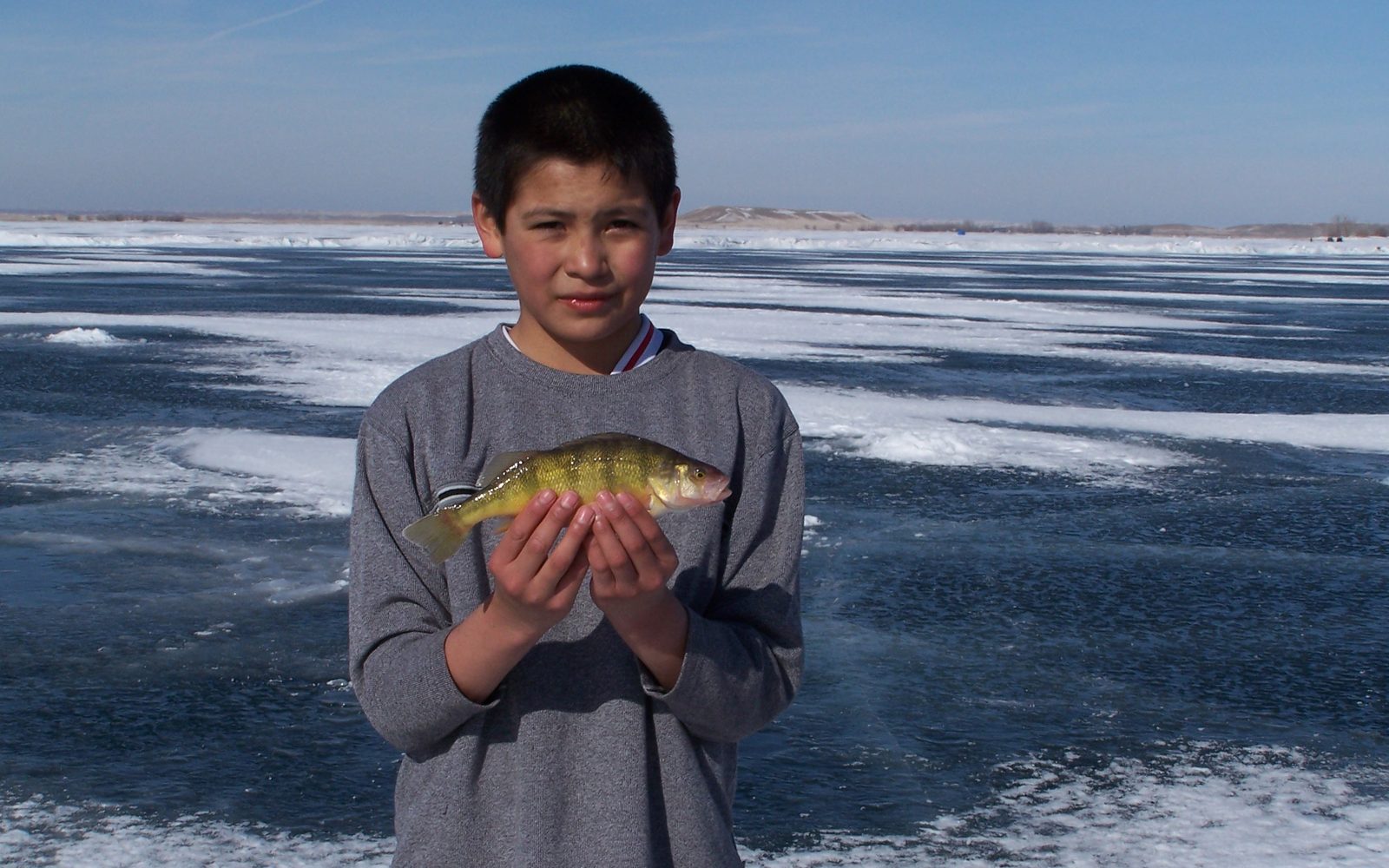
Agencies set 4 inches of clear, solid ice as the minimum for walking out. Read ice thickness safety before you drill your first hole.
Where perch sit under the ice
Wisconsin DNR says yellow perch remain active through winter, which is why they are a favorite with ice anglers. They often move down to the lake depths and feed exclusively off the bottom, and they travel in schools, often numbering in the hundreds. Depth varies by water, so the numbers are state-specific:
| Agency | Depth reported |
|---|---|
| New York DEC | Close to the bottom, from weed beds under 10 ft to flats in 40 ft |
| Montana FWP | 10–40 ft (eater-sized perch on standard jigging tackle) |
| Washington WDFW | 20–50 ft on some lakes |
| Wisconsin DNR | 40–60 ft on some lakes; one example jigs at 35 ft |
Find the school
Perch are schooling fish, so the job is to find the group. Washington’s method is to start near the bottom and work toward the surface before moving to a new spot. Wisconsin says that if a spot is unproductive after a few tries, move until you locate a school. New York’s rule is to fish within a foot or less of the bottom, where perch are usually found, and to keep the bait there: “the key to catching perch is keeping your bait near the bottom.”
Once they start biting, get your line back in the water quickly, because the increased action creates a feeding frenzy (NY). If all you catch are little ones, try a different area or deeper water (NY). Washington calls perch notorious bait thieves, so once you have found a school, give them time to nibble so you don’t pull up a bare hook.
Jigs, line and rod
Wisconsin describes short jig poles, some with specialized spools large enough to hold 50 to 60 feet of line. Small, colorful, tear-shaped jigs baited with grubs such as wax worms or mousies (larvae of flying insects) are the bait of choice for many Wisconsin ice anglers. New York says Castmasters and Swedish pimples tipped with wax worms work well, and Montana names Swedish pimples and Hali jigs on standard jigging tackle.
New York’s ice table for sunfish, perch and crappie:
| Hook size | Line (lb test) | Auger size | Jigging rod power |
|---|---|---|---|
| 6–8 | 4–6 | 4–6 in | Ultra-light |
Bait
- Live bait and larvae. Wisconsin says to try small live minnows, weighted ice flies and insect larvae. Montana says perch are generally caught in deeper water with standard jigging tackle and maggots or wax worms.
- Tip-ups. New York suggests setting tip-ups baited with small minnows, or jigging small jigs tipped with spikes. The tip-up guide shows how to rig and set one.
New to the sport? Start with ice fishing for beginners for the gear, hole size and first-trip steps.
Sources
- Panfish, New York State DEC
- Yellow perch (species sheet, PDF), Wisconsin DNR
- Ice fishing techniques, Wisconsin DNR
- Yellow perch, Wisconsin DNR
- Ice fishing (learn-to-fish guide, PDF), New York State DEC
- Ice fishing (I FISH NY lesson plan, PDF), New York State DEC
- Ice fishing, Montana Fish, Wildlife & Parks
- Yellow perch (Perca flavescens), Washington Department of Fish and Wildlife
- Winter fishing tips, Oklahoma Department of Wildlife Conservation