

- Jigging rod
- 2–3 ft (NY, MO); 18–24 in (IA)
- Hole size
- 6–8 in (MO); 10 in max (IA)
- Best times
- Early morning, late afternoon
- Start depth
- 6–12 in off bottom (MO)
Agencies set 4 inches of clear, solid ice as the minimum for walking out (New York’s guides say 3 to 4 inches in one place and 4 on its table), and Colorado and New York say to stay off ice of 2 inches or less. Thickness varies across one lake, so drill test holes as you go. The full numbers are on the ice thickness safety page.
What you need
Montana FWP’s first item is “something to measure the ice with.” After that the list is short, and Missouri notes that ice fishing needs no boat or expensive gear.
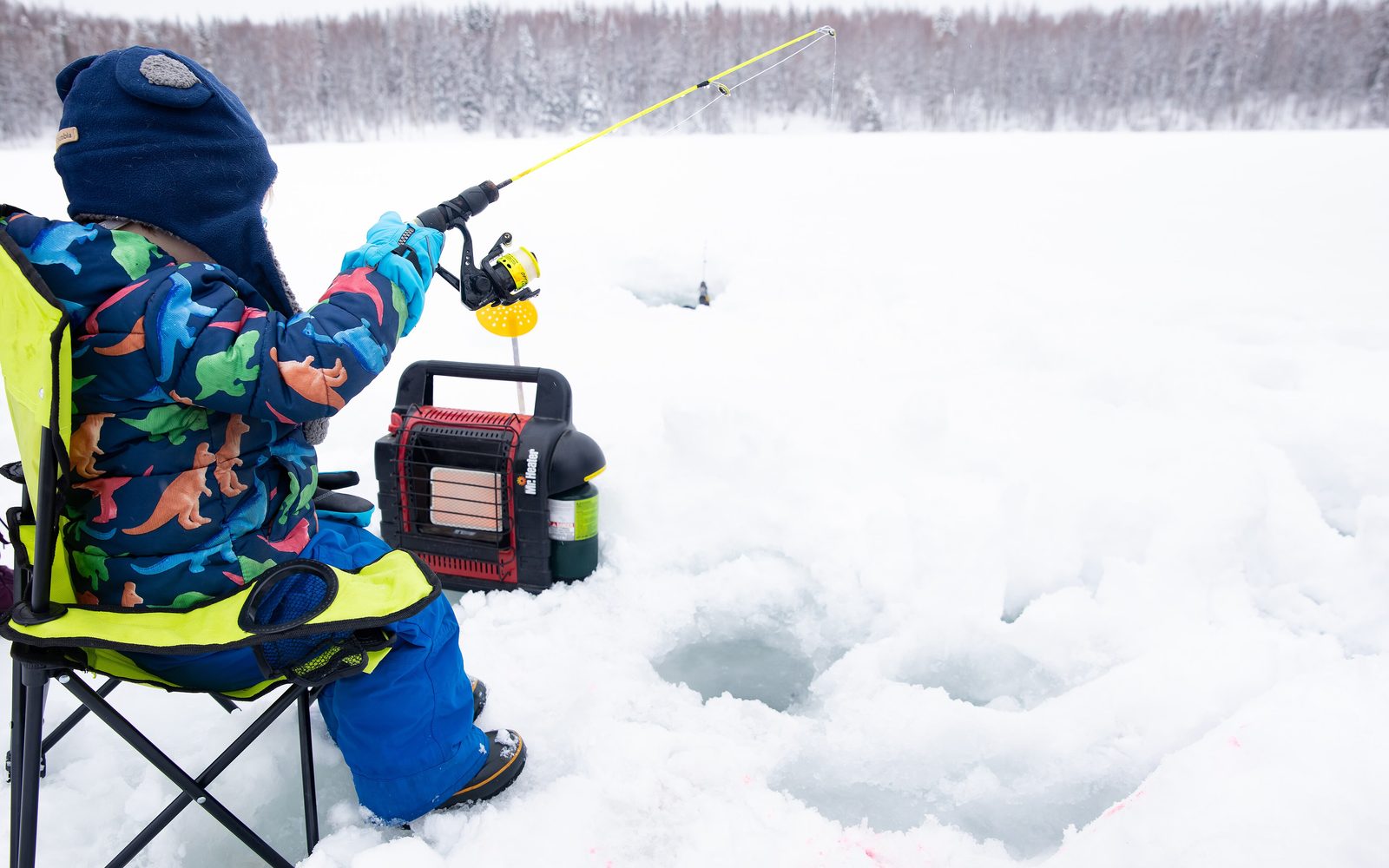
- Rod and reel. Jigging rods are short: 2 to 3 feet according to New York and Missouri, 18 to 24 inches according to Iowa. A small spinning reel spooled with monofilament works best in most situations (NY). Washington says any old rod will do.
- Auger or spud bar. A spud bar is a heavy chisel; tie a lanyard to it so you don’t lose it through the ice (NY). Hand augers are lighter and cheaper but take more effort. Power augers cut quickly but are heavier, cost more and may be restricted on some waters (NY). Missouri says affordable hand augers are all you need, since ice there rarely passes 12 inches.
- Scoop or skimmer. Needed to clear slush and ice chunks from the hole (NY).
- Bucket. It carries gear, works as a seat and hauls your catch. Iowa adds that, turned upside down to trap air, it can serve as an emergency flotation device if you fall through.
- Hooks, jigs and line. Small hooks, small bait and light line (Iowa). Missouri’s advice is to use the smallest presentation and the lightest line you can find.
- Optional electronics. Fish finders and underwater cameras are not necessary, but they can help with depth, structure and fish movement (NY).
Hook, line, auger and rod by species
New York DEC’s beginner table sizes the whole kit to the fish you are after.
| Species | Hook size | Line or leader (lb test) | Auger size | Jigging rod power |
|---|---|---|---|---|
| Sunfish, perch, crappie | 6–8 | 4–6 | 4–6 in | Ultra-light |
| Trout, walleye, pickerel | 4–6 | 6–10 | 6–8 in | Medium |
| Lake trout | 4–6 | 8–12 | 8 in or more | Medium-heavy |
| Northern pike | 1–2 | 10–17 | 8 in or more | Medium-heavy |
Source: New York State DEC. New York also notes that cutting an 8-inch hole removes almost twice as much ice as a 6-inch hole, so don’t buy an auger much bigger than you need.
Your first trip, step by step
- Check the ice and tell someone. Measure the ice, wear cleats and carry ice picks (see the safety page). Washington says never to fish alone.
- Pick a spot like you would in summer. Weed lines, humps, depth changes and points (NY). On a small pond Missouri suggests the deepest part, which is next to the dam. Panfish school in winter, so where you find one there should be others (NY).
- Drill the hole and clear it. Missouri says 6 to 8 inches is a standard diameter. Scoop out slush and ice chunks.
- Drop your bait near the bottom. Missouri starts 6 to 12 inches off the bottom; Colorado starts 6 to 10 inches off and will also fish the whole water column.
- Jig, then pause. Jig the bait a few times, then pause it for a few seconds; fish generally hit during the pause (NY). Keep the bait moving with very subtle twitches of the rod tip (MO). Colorado’s example is jigging for 30 seconds and letting the bait sit still for a minute.
- Move if nothing bites. Fish are lethargic, eat less often and are less aggressive in winter (Iowa), so work a few holes. A bite often shows first on a spring bobber, a thin steel wire clipped to the rod tip that often shows a bite before you feel it (Iowa).
Bait and lures
Most lures are tipped with bait. Missouri says most successful anglers use live bait such as wax worms (the larvae of the greater wax moth) and small minnows like fatheads and shiners. New York names minnows and the fly larvae called spikes or mousies. Iowa pairs wax worms or wigglers (mayfly larvae) on a small teardrop lure for bluegill and crappie. Colorado’s two recommended trout baits are live wax worms and small cooked salad shrimp from the grocery freezer case.
When and where
Early morning and late afternoon tend to be best, and midday is generally less productive (NY). Iowa puts fish at their most active from dawn to mid-morning and from late afternoon to sundown. Colorado’s peak windows are 6 to 10 a.m. and 2 to 6 p.m. In the western states Colorado finds trout in semi-shallow water, 8 to 12 feet deep.
Methods: jigging and tip-ups
The two main methods are jigging with a short, light rod and fishing tip-ups (NY). A tip-up holds a baited line through the hole and flags when a fish bites, so you can fish several holes at once. See tip-ups explained for rigging. For the most popular panfish, start with ice fishing for perch or ice fishing for crappie.
Dress for the day
New York says to dress in layers, starting with a layer that wicks moisture from the skin, and to avoid cotton, which loses its warmth when wet. Add cleats to your boots to prevent falls (NY). Iowa suggests many thin layers of loose clothing.
Iowa requires unattended shelters to show the owner’s DNR number or full name and address, and to be off the ice before ice melt or March 1. New York requires the owner’s name and address in letters at least 3 inches high and removal by March 15. Utah DWR says its officers’ most common ice fishing violations are fishing without a license or with an expired one, and keeping more than the daily limit. Check your own state agency before you go.
Good habits on the ice
- Bait and water. Never dump unused baitfish or water from your bucket into a lake or pond (NY). The U.S. Fish & Wildlife Service says never to transport water between lakes and to use commercial bait at only one body of water.
- Releasing fish. Utah says water on the gills or eyes can start to freeze and cause damage, so minimize exposure time, release the fish quickly and remove your gloves before handling it.
Frequently asked questions
What do I need to start ice fishing?
A short jigging rod with a small spinning reel and light monofilament, a bucket, an auger or spud bar, a scoop for slush and a way to measure the ice, plus small hooks and bait.
How big should an ice fishing hole be?
Missouri says 6 to 8 inches. Iowa says no larger than 10 inches. New York's gear table lists 4 to 6 inches for panfish, 6 to 8 for trout, walleye and pickerel, and 8 inches or more for lake trout and pike.
When is the best time of day to ice fish?
Early morning and late afternoon. New York says midday is generally less productive, and Colorado's peak windows are 6 to 10 a.m. and 2 to 6 p.m.
Do I need an electric auger?
No. New York says hand augers are lighter and cheaper but take more effort, while power augers cut quickly but cost more, weigh more and may be restricted on some waters. Missouri says affordable hand augers are all you need there.
Sources
- Ice fishing, Colorado Parks & Wildlife
- How to ice fish, New York State DEC
- Ice fishing in New York, New York State DEC
- Ice fishing (learn-to-fish guide, PDF), New York State DEC
- Ice fishing (I FISH NY lesson plan, PDF), New York State DEC
- Ice fishing, Montana Fish, Wildlife & Parks
- Ice fishing, Missouri Department of Conservation
- Ice fishing, Washington Department of Fish and Wildlife
- Ice fishing safety and etiquette, Utah Division of Wildlife Resources
- Ice fishing tips, U.S. Fish & Wildlife Service
- Ice fishing, Iowa DNR
- Winter fishing tips, Oklahoma Department of Wildlife Conservation