
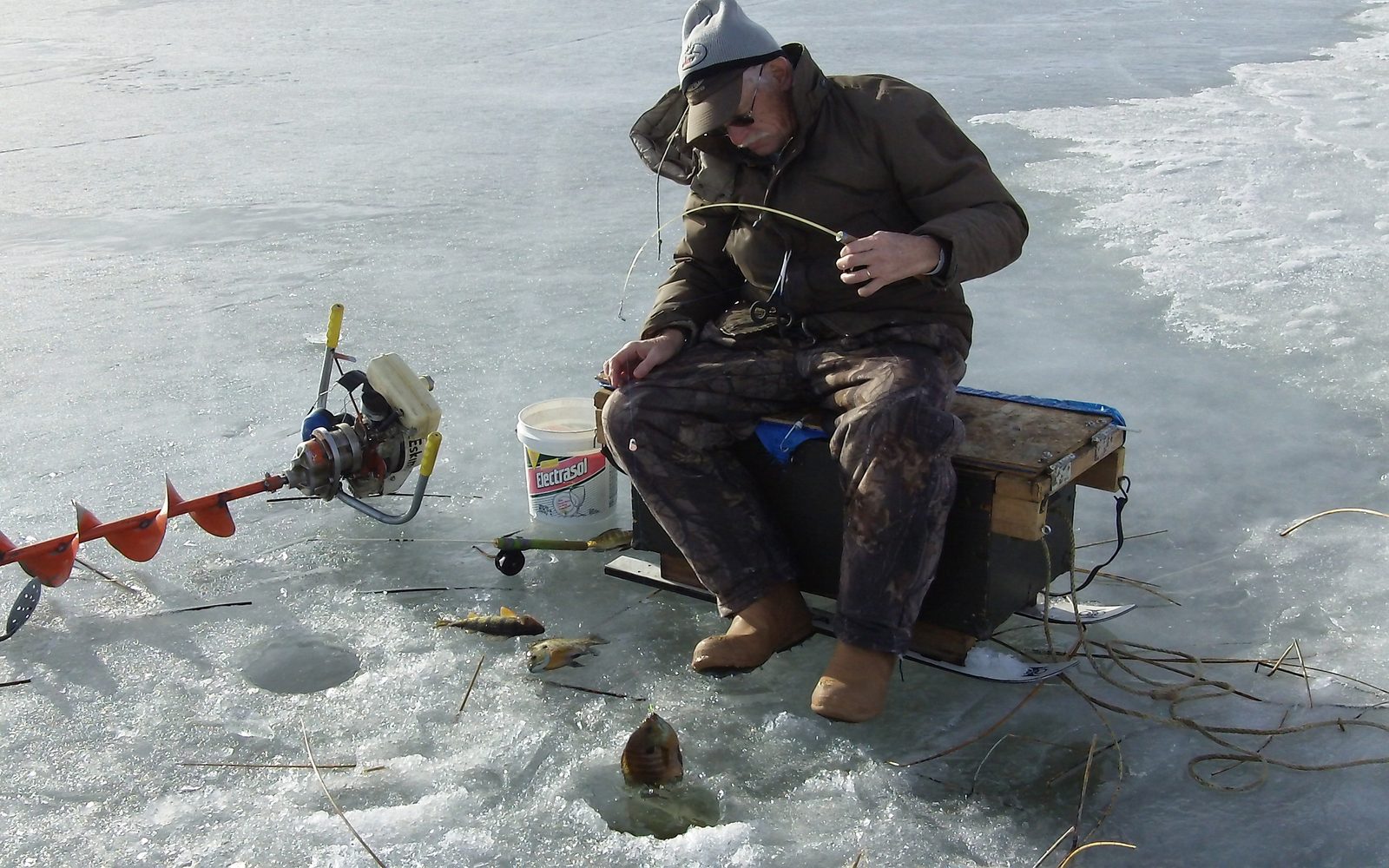
New York’s table applies to new, clear ice on non-running water. Slush ice is about 50 percent weaker, and clear ice over running water about 20 percent weaker. Washington notes that lake ice is unpredictable and that its agency does not monitor ice conditions. Missouri says it is impossible to tell whether ice will hold you just by looking at it from the bank.
How many inches for what
| Load | New York DEC | Colorado CPW | U.S. Fish & Wildlife Service |
|---|---|---|---|
| Stay off | 2 in or less | 2 in or less | not listed |
| On foot, ice fishing | 4 in | 4 in | 4 in |
| Snowmobile or ATV | 5 in | 6 in | 5–7 in |
| Car or small pickup | 8–12 in | 8–12 in | 8–12 in (vehicles) |
| Medium truck or pickup | 12–15 in | 12–15 in | not listed |
Other agencies agree on the walking minimum. Maryland DNR says never to walk or ice fish unless there is at least 4 inches of clear, solid ice underfoot. Washington, Missouri, Utah and Iowa also give 4 inches, and Iowa specifies clear blue ice. New York’s general rule appears as both “a minimum of four inches” and “a minimum of three to four inches” of solid ice in different New York guides, so treat 4 inches as the floor.
Clear ice versus white ice
The strongest ice is clear and blue; white or gray ice is much weaker, and Colorado says to only consider traveling on clear, blue ice. The National Park Service gives the general rule as at least 4 inches of clear ice or 8 inches of white or “snow ice,” which it calls half as strong as clear ice. New York says to double the recommendations for white ice. New ice is stronger than old ice (Colorado, Iowa), and Missouri says to wait for local highs to stay well below 32 degrees for several days before walking out.
Ice thickness changes across one lake
Ice rarely forms in uniform thickness; Missouri’s example is 6 inches in one spot and 2 inches a few feet away. Utah says that if the ice is 4 inches thick in one place, don’t assume it is across the lake. So you test as you go, and the spacing differs by agency:
- Colorado: test holes at no more than 30-foot intervals.
- Missouri: if there is at least 4 inches, continue another 10 or 15 feet and make another hole; once things look safe, open holes every 50 feet to confirm the thickness hasn’t changed.
- National Park Service and New York: if you are unsure of the thickness, drill regular test holes as you go, at least every 150 feet.
Where ice is weaker
- Submerged trees, brush and vegetation. Iowa says ice around submerged trees and emergent vegetation tends to be weaker. Colorado adds that partially submerged objects, such as trees, brush, embankments and structures, can hold heat and weaken ice.
- Inlets, outlets, springs and moving water. Maryland says ice can vary in thickness at stream inlets and outlets because of the erosive action of the current. The National Park Service says always to avoid ice near moving or open water, feeder streams and springs, and also dark, honeycombed or porous ice.
- Pressure ridges. Colorado says ice may be unstable up to 20 feet from the ridge.
- Bubblers. New York says bubblers used to protect docks can produce thin, unsafe ice some distance away.
- Snow-covered ice. Snow acts like a blanket, insulating thin ice and keeping clear, blue ice from forming (Colorado). Missouri adds that snow doesn’t help ice freeze faster.
What to carry and how to go
- Ice picks. Colorado says to always carry ice picks or screwdrivers that will float, securely connected with a piece of nylon cord 24 to 30 inches long. Iowa says to wear picks around your neck. New York describes safety picks as two handles with spike points; Maryland suggests large nails, ice picks or wooden-handle screwdrivers.
- Rope and flotation. Iowa lists a life jacket, a floating safety rope and a whistle; Colorado says to prepare 50 feet of nylon rope with a large loop tied at each end. Maryland suggests a life vest worn under your winter coat.
- Cleats, dry clothes and warmth. Iowa also lists ice cleats, hand warmers, a first aid kit and extra dry clothes, including gloves.
- Never alone. Washington and Maryland say never to fish alone, and Maryland says to tell someone where you are going and when you expect to return.
- Spread out. Spread your party out to avoid too much weight on one area of ice (Washington), and avoid putting large groups and equipment in one small area (Utah).
If someone falls in
If you go through, Colorado says the safest place to pull yourself back up is the last place you stepped before you went through. Once you are lying on the ice, roll away from the weak or broken ice and don’t try to stand. If someone else falls in, the National Park Service’s order is Reach (a long stick or fishing pole), Throw (a rope, a life jacket, anything that floats), Row (row or push a boat) and Go (call for help). In Maryland, call 911 or the Natural Resources Police dispatch center at 410-260-8888.
Next: ice fishing for beginners covers the gear and the first trip, and tip-ups covers fishing several holes at once.
Sources
- Ice fishing, Colorado Parks & Wildlife
- Ice fishing in New York, New York State DEC
- Ice dangers and safety, Maryland DNR
- Ice fishing (learn-to-fish guide, PDF), New York State DEC
- Ice fishing (I FISH NY lesson plan, PDF), New York State DEC
- Ice fishing, Missouri Department of Conservation
- Ice fishing, Washington Department of Fish and Wildlife
- Ice fishing safety and etiquette, Utah Division of Wildlife Resources
- Ice fishing tips, U.S. Fish & Wildlife Service
- Ice fishing, Iowa DNR
- Ice fishing safety on the Upper Delaware, National Park Service