

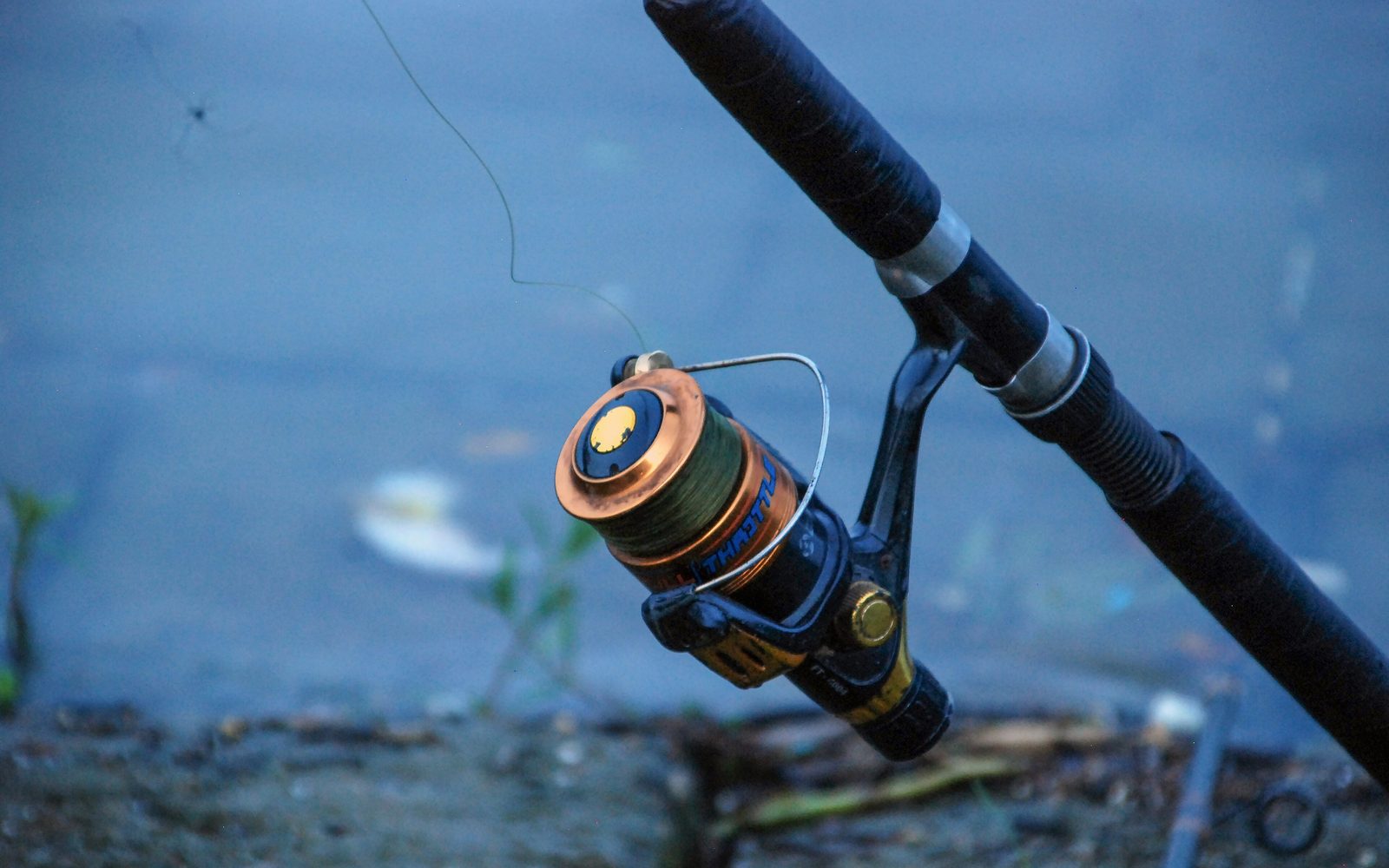
What you need
Every setup uses the same few parts: a rod and reel with line, a hook and weight (Oklahoma DWC). The type of rod and reel and the sizes of line, hook and weight depend on the species you want to catch. New York DEC says a beginner needs only a small investment in a rod and reel, a hook, line and some kind of bait or lure.
Set up the rod
- Match the rod to the reel. Casting reels (baitcast and spincast) sit on top of the rod, while a spinning reel hangs below it, so the rods differ (Oklahoma DWC). A spinning rod has large guides that get smaller toward the tip, a straight handle with no finger grip, and the reel mounts on the bottom (South Carolina DNR). Casting rods have a pistol-grip or straight handle with the guides on top (Texas Parks & Wildlife). Still choosing? See fishing reel types.
- Read the rod label. Most rods are stamped near the base, just before the handle, with the length, action and recommended line weight (Oklahoma DWC). New York DEC says to use that information to choose the rod you need.
- Run the line through the reel and the guides. Outdoor Alabama says to run the line through the reel and each circular guide of the rod. On a spinning reel, open the bail before you bring line from the reel to the guides. On a spincast reel, the line goes through the hole in the cover. On a baitcast reel, it goes through the level-wind, the part that moves back and forth to lay line evenly on the spool.
- Tie the line to the spool with an arbor knot. Pass the line around the spool (the arbor) and tie an overhand knot around the main line. Tie a second overhand knot in the tag end, pull the tag-end knot tight and clip off the excess, then snug the first overhand knot down on the reel (Texas Parks & Wildlife). The full routine is in how to spool a spinning reel.
- Fill the spool, but not to the rim. New York DEC says to leave 1/8 inch of space from the edge of the spool for best casting. Missouri’s web guide says the reel is full at about 1/16 inch from the edge, and its printed intro guide says 1/8 inch.
- Tie on the hook or lure. New York DEC notes that some knots are stronger than others, and Texas Parks & Wildlife calls the palomar the easiest to tie and the strongest knot known to hold terminal tackle. Florida FWC says to match the knot to its job, wet it before fully tightening and trim the tag end to 1/8 inch once it is tight. Pick the hook from fishing hook sizes.
- Add a sinker or bobber. Texas Parks & Wildlife puts the sinker 4 to 8 inches above the hook for live bait. Oregon’s wildlife department puts split shot about 6 inches above a baitholder hook. For a bobber, South Carolina DNR says two feet from the end of the line is a good place to start, and Indiana DNR says to squeeze BB-sized split shot onto the line one at a time until the bobber nearly sinks.
- Set the drag. Set it to release line before the breaking point (Missouri). New York DEC recommends about 25% less than the pound test of your line; Outdoor Alabama says normally less than a quarter of the line’s breaking strength. If the line breaks, loosen the drag. If the line comes off too easily, tighten it (NY DEC).
- Let the lure hang before you cast. Outdoor Alabama says the lure should hang 1 to 3 inches from the rod tip. New York DEC sets a casting plug, lure or bait 6 to 12 inches from the tip. Missouri starts with a plug hanging 1 inch below the tip, then experiments.
New York DEC says to attach the hook to a rod line guide when you are not fishing, so it cannot swing into branches or people, and to always walk when holding a rod, never run.
Rod length, action and power
Agencies start beginners on a light to medium rod of about 5.5 to 7 feet.
| Source | Length | Action and line |
|---|---|---|
| Oklahoma DWC (freshwater spinning and casting) | 5 to 6.5 ft; 5.5 ft is a good starting point | Medium action for beginners |
| New York DEC (all-around starter) | 6 to 6.5 ft spinning rod | Medium action |
| Missouri MDC (starter) | 5.5 to 6.5 ft | Medium-light, with a reel for 4 to 12 lb line |
| Virginia DWR (bluegill lures) | 5.5 to 6.5 ft | Light action, spinning reel, 4 to 6 lb line |
| New York DEC (bass) | 6.5 to 7 ft spinning rod | Medium action, 8 to 10 lb monofilament |
New York DEC adds that a beginner should use a rod that is their height or shorter for better control.
Action is the part of the rod that bends. South Carolina DNR describes fast action as bending mainly near the tip, good for surface lures or detecting subtle strikes when jigging, and medium action as bending over the front half or three quarters of the rod, good for live bait fishing. Oklahoma DWC puts it simply: the lighter the action, the more flexible the rod, and a rod with heavier action is stiffer.
Power is the amount of force needed to bend the rod, measured as light, medium and heavy, or on a scale of 1 to 10 where 1 is the lightest (South Carolina DNR). For what the line rating on the label means, see fishing line pound test.
Your first rig
New York DEC calls a bobber-and-bait rig the best for beginners because the bobber tells you when a fish takes the bait. A bottom rig is a great choice for species that feed on the bottom, and it is also good on windy days when a bobber is hard to use.
Frequently asked questions
How long should a beginner's fishing rod be?
Oklahoma DWC says freshwater spinning and casting rods run 5 to 6.5 feet and 5.5 feet is a good starting point. New York DEC calls a medium action 6- to 6.5-foot spinning rod a good all-around starter, and Missouri suggests 5.5 to 6.5 feet in medium-light.
What do rod action and power mean?
Action is the part of the rod that bends: fast bends mainly near the tip, medium bends over the front half to three quarters of the rod (South Carolina DNR). Power is how much force it takes to bend the rod, rated light, medium or heavy, or 1 to 10 with 1 the lightest.
How tight should I set the drag?
Set it to slip before the line breaks. New York DEC recommends about 25% less than the pound test of your line, while Outdoor Alabama says it should normally be less than a quarter of the line's breaking strength. If the line breaks, loosen the drag; if line comes off too easily, tighten it.
How far above the hook does the sinker go?
Texas Parks & Wildlife places the sinker 4 to 8 inches above the hook so live bait looks natural. Oregon's wildlife department puts split shot about 6 inches above a baitholder hook.
Sources
- Chapter 2: Fishing tackle and supplies, Oklahoma Department of Wildlife Conservation
- Learn-to-fish guide: fishing basics (PDF), New York State DEC
- Learn-to-fish guide: tackle and casting (PDF), New York State DEC
- Wacky rigs for bass fishing, New York State DEC
- Rigging your pole, Missouri Department of Conservation
- Intro to fishing (PDF), Missouri Department of Conservation
- Fishing basics, Florida Fish and Wildlife Conservation Commission
- Favorite warmwater fishing rigs, Oregon Department of Fish and Wildlife
- Learn to fish: tips and videos, Indiana DNR
- Fishing basics handbook (PDF), Texas Parks & Wildlife Department
- South Carolina fishing guide (PDF), South Carolina DNR
- Basic fishing tips (PDF), Outdoor Alabama, Alabama Department of Conservation and Natural Resources
- Bluegills three ways, Virginia Department of Wildlife Resources