

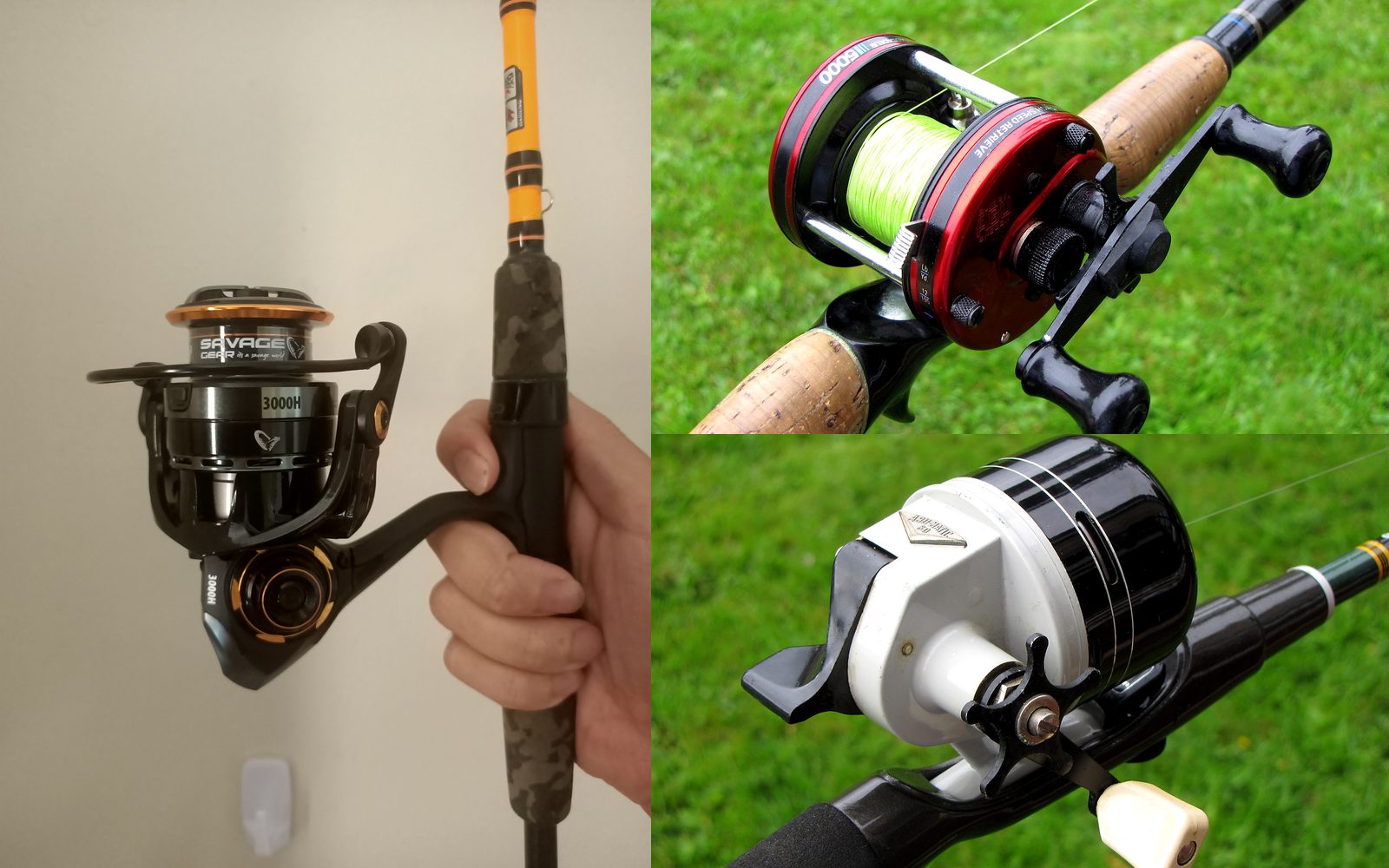
The three casting reels compared
| Spincast | Spinning | Baitcasting | |
|---|---|---|---|
| Also called | Closed face, push-button reel | Open face, flip-bail reel | Bait-casting reel |
| Mounts | On top of the rod | Hangs below the rod | On top of the rod |
| How you cast | Push a button to release the line | Lift the bail, hold the line between your finger and the rod, let go while casting | Thumb on the spool; release the line and slow or stop it with your thumb |
| Ease of use | Easiest; recommended for beginners; difficult to tangle | A bit more difficult; one of the more common reels used by experienced anglers | Hardest of the three to master; settings need adjusting |
| Strengths | Spool does not move, so no backlash tangles | Line spools off quickly and casts farther than spincast; casts lighter baits and lures | Casts heavier lures and weights; higher gear ratios; good for casting accuracy |
| Watch for | Not best for very light or heavy line; needs regular maintenance in saltwater to prevent corrosion | Line twist can require removing the line and respooling | High potential for backlash tangles; takes practice |
Sources: Oklahoma DWC, Florida FWC, Texas Parks & Wildlife, South Carolina DNR, Outdoor Alabama, New York DEC.
Spincast
Oklahoma DWC calls spincast reels the most basic and easiest to use. They are also known as closed face or push button reels, and because the spool does not move they eliminate backlash tangles (Florida FWC). Outdoor Alabama says spincast gear is not the best choice for very light or very heavy line. Florida FWC says these reels are good in freshwater and need regular maintenance in saltwater to prevent corrosion.
Spinning
The spool is open and the reel hangs underneath the rod instead of sitting on top, which makes it a bit more difficult to use than a spincast (Oklahoma DWC). New York DEC lists these advantages over spincast: typically a better drag system, more line held, and easier casting of lightweight lures and baits. Its disadvantages: they cost more and sometimes have annoying line twist, requiring that you remove the line and respool. South Carolina DNR calls spinning reels suitable for light lures in salt and fresh water, and Outdoor Alabama says spinning gear can be used for all species of fish. To load one, see how to spool a spinning reel.
Baitcasting
Baitcast reels are designed so the spool that holds the line rotates when letting line out or retrieving it, and they have a high potential for tangles and take practice to fish properly (Florida FWC). Oklahoma DWC describes them as a hybrid: the line is exposed on the spool as on a spinning reel, but the reel sits on top of the rod and the thumb releases the line, like a spincast. New York DEC says they generally cast heavier lures or weights than other gear. Learn the cast in how to cast a baitcaster, or weigh the two in spinning vs baitcasting.
Conventional, fly and cane pole
- Conventional. Florida FWC says these rods and reels are generally used to catch large fish from offshore, mostly for trolling or bottom fishing, not casting.
- Fly. A fly rod and reel uses the weight of the line to carry the lure to the fish (Florida FWC). Oklahoma DWC adds that the fly reel hangs below the rod like a spinning reel, but the line, not your bait, is the weight that is cast.
- Cane pole. No reel at all. A piece of line the same length as the pole is attached, along with a float and a hook (Florida FWC). Outdoor Alabama ties the line to the tip of the pole.
How many types are there?
The count depends on the source. Florida FWC lists six main types of reels: spincast, spinning, conventional, bait-casting, fly and cane. New York DEC’s beginners’ guide names four main rod-and-reel types: spin-casting, spinning, bait-casting and fly. A New York DEC lesson plan lists four reel types: spincasting, spinning, baitcasting and conventional.
Matching the rod
Rods are not interchangeable. Casting reels (baitcast and spincast) sit on top of the rod, and spinning reels hang below, so the rods differ (Oklahoma DWC). Florida FWC notes that rod style should be stiff for offshore rods and give a fair amount for inshore rods. For the full rod and reel setup, see how to set up a fishing rod.
Frequently asked questions
How many types of fishing reels are there?
It depends on who counts. Florida FWC lists six main types: spincast, spinning, conventional, bait-casting, fly and cane pole. New York DEC's beginner guide lists four main rod-and-reel types: spin-casting, spinning, bait-casting and fly.
What is the easiest fishing reel to use?
The spincast. Oklahoma DWC calls it the most basic and easiest to use, recommended for any beginning angler because it is easy to operate and difficult to tangle.
What is the hardest reel type to use?
Baitcasting reels, according to Oklahoma DWC and South Carolina DNR. New York DEC says bait-casting and fly rods are considered the hardest to use.
Which reel can use any rod?
None. Casting reels sit on top of the rod and spinning reels hang below, so the rods differ (Oklahoma DWC).
Sources
- Fishing basics, Florida Fish and Wildlife Conservation Commission
- Learn-to-fish guide: fishing basics (PDF), New York State DEC
- Learn-to-fish guide: tackle and casting (PDF), New York State DEC
- Backyard bass (I FISH NY lesson plan, PDF), New York State DEC
- Fishing basics handbook (PDF), Texas Parks & Wildlife Department
- South Carolina fishing guide (PDF), South Carolina DNR
- Basic fishing tips (PDF), Outdoor Alabama, Alabama Department of Conservation and Natural Resources
- Chapter 2: Fishing tackle and supplies, Oklahoma Department of Wildlife Conservation
- Learn to fish in Oklahoma, Oklahoma Department of Wildlife Conservation