

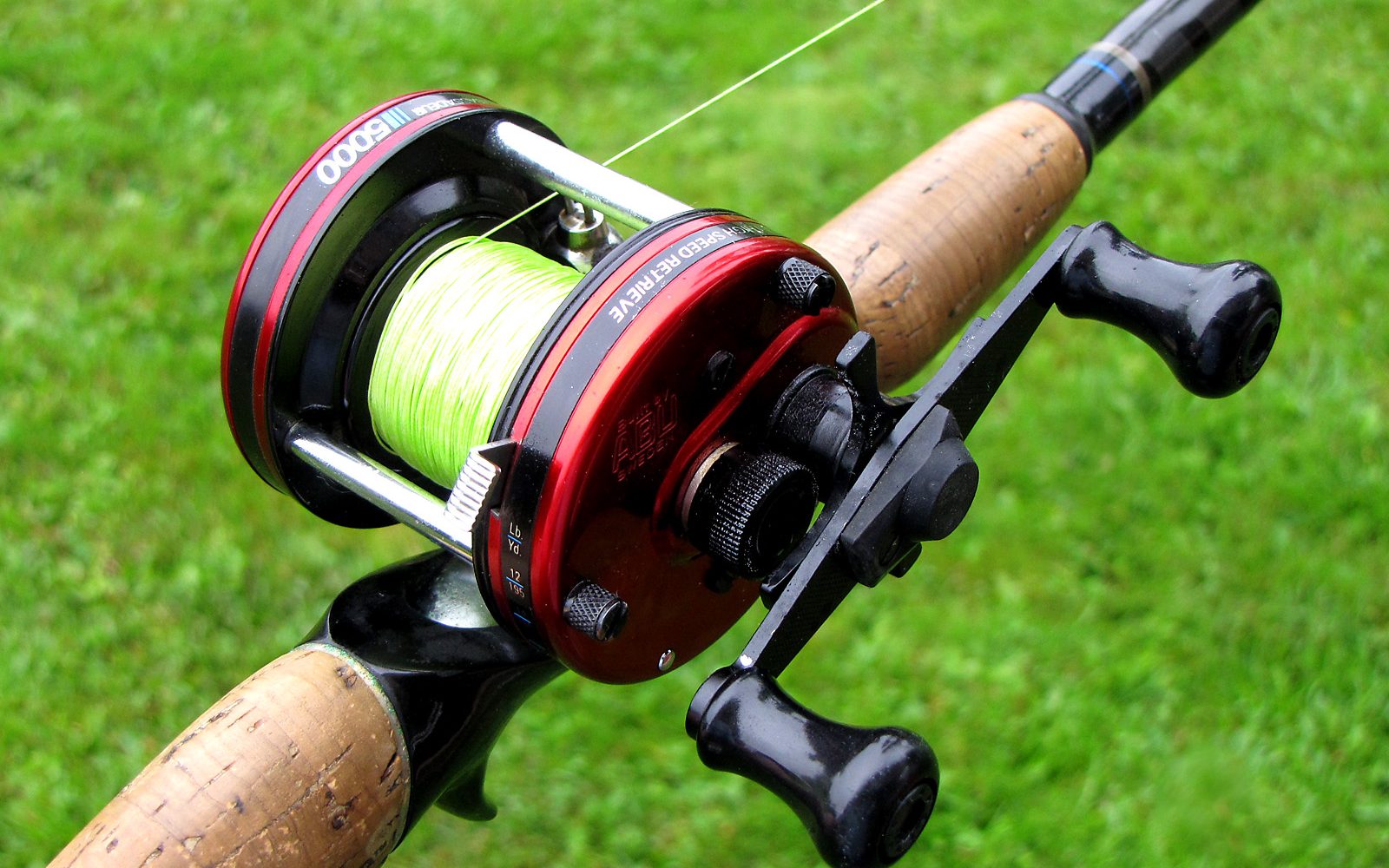
How a baitcaster differs
A baitcast reel mounts on top of the rod. Unlike spinning and spincast reels, its spool revolves during the cast and the retrieve, which reduces line twist (New York DEC). The catch, per Texas Parks & Wildlife, is that the spool turns when you cast and can tangle the line if it is not adjusted. Your thumb releases the line and slows and stops it (Outdoor Alabama). If the timing is off, the line backlashes, a tangle that forms when the spool keeps rotating after the plug stops.
The five steps
Texas Parks & Wildlife teaches the cast with a practice plug on the ground.
- Set the spool tension. Push the reel’s thumb button down and put your thumb on the spool. Release the line so the practice plug falls to the ground. Adjust the spool tension knob on the side of the reel until the spool stops when the plug hits the ground. It may take a couple of tries, and it reduces backlash when you cast.
- Stand and aim. Face the target area with your body turned at a slight angle, about a quarter turn. Aim the rod tip toward the target, about level with your eyes.
- Bring the rod back. Swiftly and smoothly bend your arm at the elbow, raising your hand with the rod until it almost reaches eye level. When the rod is almost straight up and down, the weight of the plug bends it back.
- Swing forward. As the rod bends, move your forearm forward with a slight wrist movement.
- Release and brake. When the rod reaches eye level, lift your thumb off the spool. As the plug hits the ground, put your thumb back on the spool to reduce backlash.
Fix your timing
- Plug lands close in front of you: you released your thumb too late.
- Plug goes more or less straight up: you released it too soon.
Texas Parks & Wildlife gives those two fixes. Outdoor Alabama’s general overhand-cast advice follows the same logic: if the lure flies too high and falls short, hold the line a little longer; if it goes too low and falls short, release sooner.
Line and upkeep
Florida FWC’s pro-angler bass tips pair a baitcasting rod with 40- to 85-pound braid for heavy cover, and 30-pound monofilament for shiner fishing with a level-wind baitcaster, where braid floats too much. For picking a line type, see mono vs fluoro vs braid.
Arkansas Game & Fish says to oil the level wind and put a drop of oil on the bearings, just a little.
Who uses baitcasters
Alabama says bass anglers commonly use baitcasting gear, and it takes practice to master. New York DEC says baitcasters generally cast heavier lures and weights than other gear, their higher gear ratios wind in more line per turn of the handle, and many anglers rate them best for casting accuracy. Weighing it against a spinning reel? See spinning vs baitcasting.
Frequently asked questions
What is backlash on a baitcaster?
Texas Parks & Wildlife defines backlash as the spool's momentum keeping it turning after the plug hits the water or ground, so line balls up. New York DEC describes it as a tangle caused when the spool revolves faster than the line coming off the reel.
Where is the spool tension knob?
Texas Parks & Wildlife says the spool tension knob is on the side of the reel. You adjust it until the spool stops when the practice plug hits the ground.
Why does my lure land right in front of me?
You released your thumb too late. If the plug goes more or less straight up, you released it too soon (Texas Parks & Wildlife).
Is a baitcaster harder to use than a spinning reel?
Yes. South Carolina DNR calls it the most difficult reel to master, and Oklahoma DWC says baitcasting reels need settings adjusted for peak performance, while spinning and spincast reels only need the drag set.
Sources
- Fishing basics handbook, casting practice (PDF), Texas Parks & Wildlife Department
- Fishing basics handbook (PDF), Texas Parks & Wildlife Department
- Learn-to-fish guide: tackle and casting (PDF), New York State DEC
- Basic fishing tips (PDF), Outdoor Alabama, Alabama Department of Conservation and Natural Resources
- South Carolina fishing guide (PDF), South Carolina DNR
- Learn to fish in Oklahoma, Oklahoma Department of Wildlife Conservation
- Pro tips for bass, Florida Fish and Wildlife Conservation Commission
- A little tinkering brings reels back to life, Arkansas Game & Fish Commission