

Line types compared
State agencies name three main types of line: monofilament, fluorocarbon and braid (Oklahoma DWC). Florida FWC defines monofilament as a single strand of nylon. The table pulls together what Oklahoma DWC, New York DEC and Florida FWC say.
| Monofilament | Fluorocarbon | Braid | |
|---|---|---|---|
| Stretch | Most of the three | Low stretch (New York); more sensitive than mono (Oklahoma) | None, so you feel your lure or bait |
| In the water | Floats | Sinks; nearly invisible | May be more visible than mono or fluorocarbon |
| Cost | Inexpensive | About twice as much as mono (Oklahoma); expensive (New York) | Expensive; costs more than mono (Florida) |
| Knots | Good knot strength, easy to tie | Very stiff to tie (Florida) | Needs special knots (New York); palomar and uni recommended |
| Memory and handling | Has memory, stays in the shape it was stored in | Strong memory: coils and tangles easily (New York) | Difficult to untangle (New York) |
| Good for | Main line; topwater lures; crankbaits; leaders off the bottom | Leader material; clear water; finesse fishing; easily spooked fish | Casting into heavy cover; more break strength without losing line capacity |
| Watch for | Absorbs water, stretches, does not biodegrade; deteriorates in ultraviolet light | May not be as abrasion-resistant as mono (Oklahoma), while Florida lists resistance to abrasion as an advantage | Rock frays and cuts it; can cut cheap line guides and your hands |
Monofilament
Mono is the line most anglers use. New York DEC calls it the best choice for beginning anglers: inexpensive, good knot strength, easy to tie knots and works well in most fishing situations. Its downsides, per New York DEC, are that it absorbs water, stretches and does not biodegrade. Florida FWC adds that it can stretch out over time and deteriorate from ultraviolet light.
Oklahoma DWC says that because mono floats it is great for topwater lures and as a leader when fishing off the bottom. Its stretch makes it a great option for crankbaits, because the fish can turn and swim with the lure, giving you time for a good hook set.
Mono has a lot of line memory when it sits on a reel. Oklahoma DWC’s fix is to unscrew the drag clip, pop the spool off the reel and hold it under warm to hot running water, rotating it so all the line gets contact. New York DEC says that if you buy a pre-spooled reel, it is best to put fresh line on it.
Always discard or recycle monofilament properly, because it can cause harm to wildlife (South Carolina DNR).
Fluorocarbon
Oklahoma DWC says fluorocarbon is nearly invisible underwater because it has about the same refractive qualities as water, and though it stretches some it is more sensitive than monofilament. It sinks and, at about twice the price of mono, most anglers use it as a leader rather than a main line. New York DEC says fluorocarbon is used for line-shy fish such as trout because it blends into the water.
Florida FWC suggests it as leader material or in clear water, and says it can be very stiff to tie.
Braid
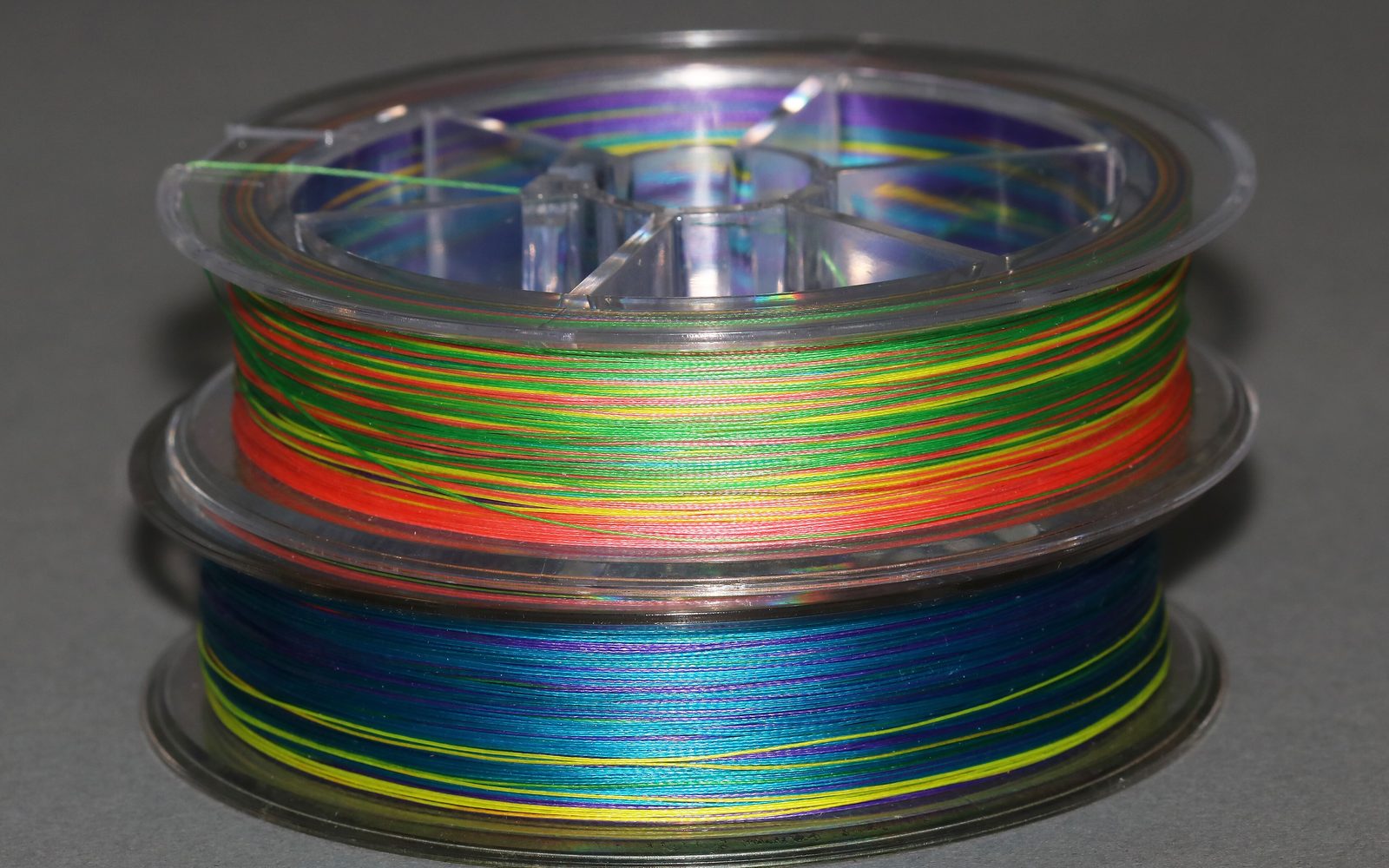
Braid has no stretch, which gives superb feel for the contact with your lure or bait, and it cuts through grass and wooden structure better than mono or fluorocarbon, so it is an optimal line for casting into heavy cover (Oklahoma DWC). Its great advantage is added break strength without sacrificing the amount of line on your reel, which helps in deep water or with a big fish that wants to take a lot of drag.
The significant disadvantage, per Oklahoma DWC, is that it may be more visible to fish than mono or fluorocarbon. Rock will fray and cut braid, which is where a mono or fluorocarbon leader helps. For the pound test and diameter of each type, see fishing line pound test.
Braid needs a leader and the right knot
- Leader. Oklahoma DWC says that, because braid has no stretch, tying it straight to the hook is a risky endeavor, especially for bank anglers. A short mono or fluorocarbon leader tied on with a double uni knot reduces stress on your rod and reel when you are snagged and cuts fishing litter. Three feet is typically enough leader with braid.
- Knots. New York DEC says the palomar is stronger than the improved clinch and a good choice for braid, which may break easily with a clinch knot. Utah DWR says the palomar works especially well with large hooks and braided line. Florida FWC says only certain knots, such as the uni knot, should be used with braid.
Florida FWC says leaders can be made of low-visibility fluorocarbon, hard monofilament, steel, titanium or other materials depending on the target species, and suggests them for large or toothy fish and sharp structure.
Which to spool first
Start with monofilament. New York DEC calls it the most popular line and the best choice for beginners. Then add a fluorocarbon leader for clear water or line-shy fish, or move to braid with a leader when you fish heavy cover.
Dacron is a different line that New York DEC says is mostly used on tip-ups for ice fishing, with a monofilament or fluorocarbon leader.
Putting line on the reel is the same job for any of these lines. Follow how to spool a spinning reel.
Frequently asked questions
What fishing line is best for beginners?
New York DEC says monofilament is the best choice for beginning anglers because it is inexpensive and works well in most fishing situations. It also calls mono the most popular line anglers use.
Is fluorocarbon invisible in water?
Oklahoma DWC says it is nearly invisible underwater because it has about the same refractive qualities as water. New York DEC lists it as invisible in water and a popular line for easily spooked fish or very clear water.
Can I tie braid straight to the hook?
Oklahoma DWC calls it a risky endeavor, especially for bank anglers, because braid does not stretch and has superior break strength, so a snag may not break the line. It suggests a short monofilament or fluorocarbon leader tied on with a double uni knot.
What knot works for braided line?
New York DEC says the palomar is stronger than the improved clinch and a good knot for braid, and warns braid may break easily with a clinch knot. Florida FWC calls the palomar one of the strongest knots for braided line and says only certain knots, such as the uni knot, should be used with braid.
Sources
- Choosing the right fishing line, Oklahoma Department of Wildlife Conservation
- Learn-to-fish guide: tackle and casting (PDF), New York State DEC
- Learn-to-fish guide: fishing basics (PDF), New York State DEC
- Fishing basics, Florida Fish and Wildlife Conservation Commission
- Learn to fish by tying knots, Utah Division of Wildlife Resources
- South Carolina fishing guide (PDF), South Carolina DNR