

Pound test chart by species
Each number below is what a state agency recommends. Agencies differ, so the ranges overlap and the source is named.
| Species | Pound test | Source and setup |
|---|---|---|
| Bluegill and yellow perch | 4 to 8 lb | New York DEC. Its panfish page says 6 to 8 lb; Virginia DWR uses 4 to 6 lb for bluegill lures on a light rod with a spinning reel. |
| Bluegill, winter (ice) | 2 to 4 lb | Wisconsin DNR: keep line light, monofilament. |
| Crappie | 4 to 8 lb | New York DEC (monofilament) and Oklahoma DWC (light to medium rod). Iowa DNR says 2 to 4 lb monofilament and not above 6. |
| Bass | 8 to 12 lb | New York DEC. Its go-to is 8 to 10 lb monofilament on a 6.5 to 7 ft medium spinning rod; wacky rigs use 8 to 12 lb monofilament, heavier in weeds. |
| Bass, drop shot | 6 to 10 lb fluorocarbon | Virginia DWR, around submerged rock piles and brush in summer and fall. |
| Bass, heavy cover | 40 to 85 lb braid | Florida FWC pro tip for baitcasting rods. |
| Walleye | 8 to 10 lb | Virginia DWR: a 6 to 7 ft medium action spinning rod spooled with 8 to 10 lb line, plus a 24 to 48 in, 8 lb test leader. |
| Trout | 6 to 8 lb monofilament | Oklahoma DWC, cast-and-retrieve on a 6 to 7 ft medium to medium-light rod. New York DEC ties an 18 to 24 in, 4 lb leader, preferably fluorocarbon, to the swivel for synthetic bait. |
| Channel catfish | 10 to 20 lb | Iowa DNR suggests 10 lb for bottom fishing near snags. New York DEC uses 15 lb for big river channel cats on a heavy rod. Oklahoma DWC's winter setup is 20 lb monofilament with a 12 to 24 in, 20 lb leader. |
| Blue and flathead catfish (live bait) | 30 to 80 lb leader | Oklahoma DWC, on a 6/0 to 10/0 circle hook with a 1/2 to 1 oz weight on the main line. |
| Freshwater drum | 15 to 20 lb mono or 20 to 30 lb braid | Arkansas Game & Fish. |
Ice fishing line and leader
New York DEC’s ice fishing table pairs line with hook size and rod power.
| Species | Line or leader | Hook size | Jigging rod power |
|---|---|---|---|
| Sunfish, perch, crappie | 4 to 6 lb | 6 to 8 | Ultra-light |
| Trout, walleye, pickerel | 6 to 10 lb | 4 to 6 | Medium |
| Lake trout | 8 to 12 lb | 4 to 6 | Medium-heavy |
| Northern pike | 10 to 17 lb | 1 to 2 | Medium-heavy |
Saltwater
Florida FWC says to use heavy line, at least 30 pound test, for pier fishing. Hawaii’s Division of Aquatic Resources lists lines of 1 to 6 pounds for small reef fish such as aholehole, hinalea, kupipi, ’u’u and ’oama.
What the number means
South Carolina DNR measures pound test as the amount of weight required to break the line, so 10 pound test is stronger and thicker than 6 pound test. Texas Parks & Wildlife adds that 6 pound is more flexible but not as strong as 12 pound. Oklahoma DWC notes the downside of stronger line is thicker diameter, which is easier for fish to see.
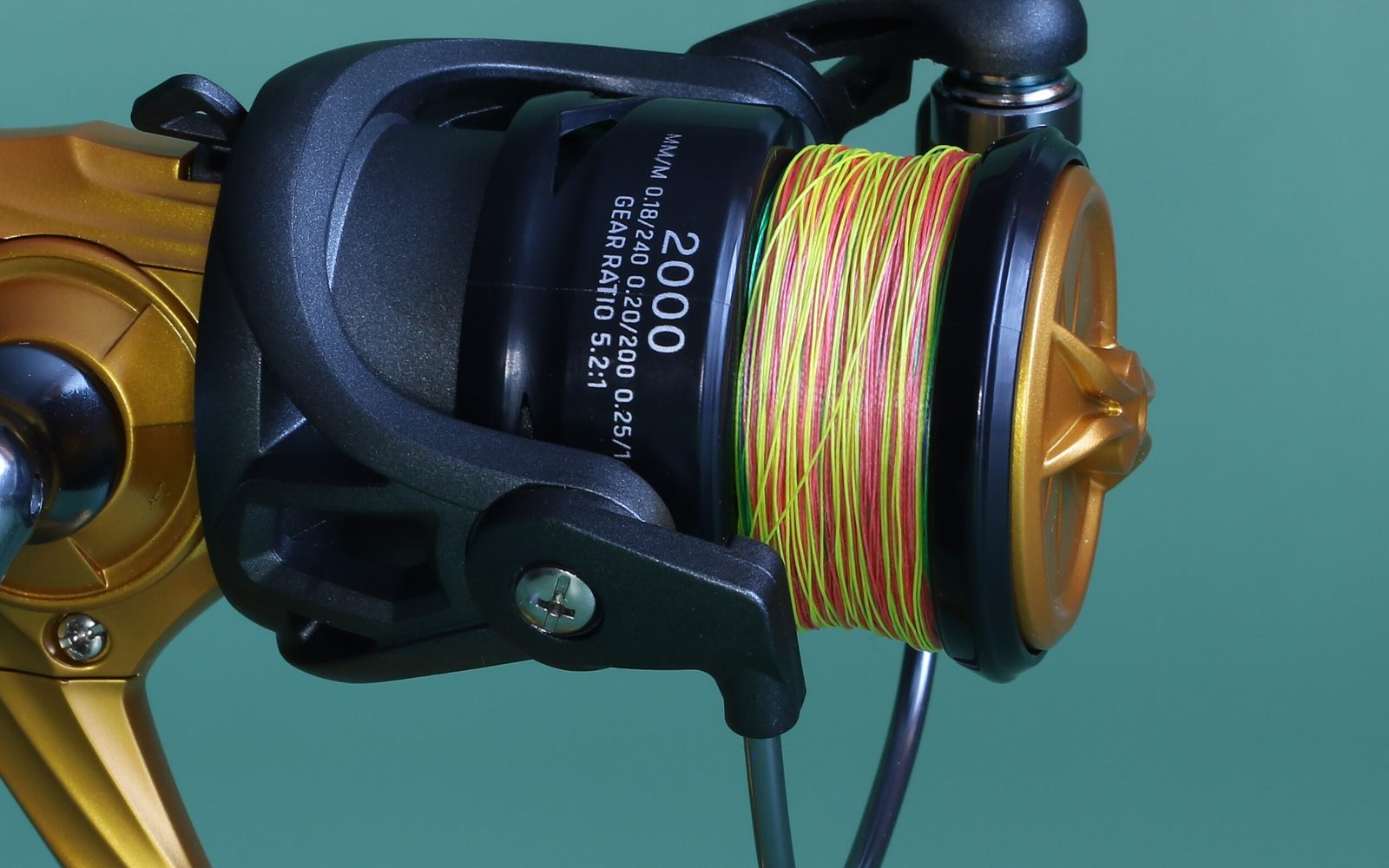
Rod and reel labels use the same numbers differently. Reels list a line poundage per yardage, such as 6 lb/210 yd, and rods list a line class, such as 6 to 10 lb. Oklahoma DWC says that is really a rating of line diameter, built around monofilament, and to stay inside the range your rod and reel recommend for casting, retrieving and fighting fish.
Because of that, the same pound test is not the same thickness:
- 10 lb monofilament is .011 inch; 10 lb braid is .008 inch (Oklahoma DWC).
- A reel rated for 180 yards of 12 lb mono holds 180 yards of 40 lb braid or 14 lb fluorocarbon.
- With 30 lb braid you can put twice as much line on a reel as with 30 lb monofilament or fluorocarbon.
For the line types themselves, see mono vs fluoro vs braid.
How to pick a pound test
- Start from the rod and reel labels. Texas Parks & Wildlife and South Carolina DNR both say to match line to the size and capability of your rod and reel, and to the lure and species.
- For an all-around start, use 8 pound. New York DEC calls it a good all-around weight, Missouri a good compromise for most, and Missouri’s medium-light rig handles 4 to 12 pound. Oklahoma DWC recommends 8 to 12 pound for beginners and most spincast reels.
- Do not overshoot. Indiana DNR says light line is your best bet unless you are after monster catfish or muskies, and Texas says heavier line is more visible and may mean fewer strikes.
- Count on the knot. Oklahoma DWC says a simple knot in 12 lb line leaves it much weaker than the advertised 12 pounds at the knot. Knot steps are in fishing knots.
Drag lets you land a bigger fish than your line is rated for, and New York DEC recommends setting it about 25% less than the pound test of the line. Outdoor Alabama’s guide says normally less than a quarter of the breaking strength. Setup steps are in how to set up a fishing rod.
Replace old line
New York DEC says old monofilament becomes brittle and loses strength, and that if your line breaks easily after you tie a knot it is time to replace it. Oklahoma DWC says line loses its effectiveness the longer it sits on a reel, especially monofilament. To put new line on, follow how to spool a spinning reel.
Record line classes
IGFA classifies a record catch by the breaking strength of the first 5 meters (16.5 feet) of line ahead of the double line, leader or hook. That section must be a single, homogeneous piece of line and may not exceed the 60 kilogram (130 pound) line class, and in freshwater the leader on all classes of tackle is limited to 1.82 meters (6 feet).
Frequently asked questions
What does pound test mean on fishing line?
It is the amount of weight needed to break the line (South Carolina DNR). A 10 pound test line is stronger and thicker than a 6 pound test line.
What pound test is best for beginners?
New York DEC calls 8 pound test a good all-around weight and Missouri calls it a good compromise for most. Oklahoma DWC recommends 8 to 12 pound test for beginners and for most spincast reels.
Is a higher pound test always better?
No. Texas Parks & Wildlife says heavier line than you need is more visible to fish and may reduce the number of strikes you get. Oklahoma DWC adds that stronger line is thicker.
Does braid have the same diameter as mono at the same pound test?
No. Oklahoma DWC's example is 10 pound mono at .011 inch against 10 pound braid at .008 inch.
Sources
- South Carolina fishing guide (PDF), South Carolina DNR
- Chapter 2: Fishing tackle and supplies, Oklahoma Department of Wildlife Conservation
- Fishing basics handbook (PDF), Texas Parks & Wildlife Department
- Intro to fishing (PDF), Missouri Department of Conservation
- Learn-to-fish guide: fishing basics (PDF), New York State DEC
- Choosing the right fishing line, Oklahoma Department of Wildlife Conservation
- Chapter 3: Knots and casting techniques, Oklahoma Department of Wildlife Conservation
- Panfish, New York State DEC
- Fishing for crappie, New York State DEC
- Trout fishing with synthetic bait, New York State DEC
- Wacky rigs for bass fishing, New York State DEC
- Wacky rig for bass (I FISH NY lesson plan, PDF), New York State DEC
- Bluegills three ways, Virginia Department of Wildlife Resources
- Drop shotting in Virginia, Virginia Department of Wildlife Resources
- Seventeen tips for catching walleyes, Virginia Department of Wildlife Resources
- Crappie, Iowa DNR
- Channel catfish, Iowa DNR
- Crappie angler guide: top tips and area highlights, Oklahoma Department of Wildlife Conservation
- Catfish angler guide: top tips and area highlights, Oklahoma Department of Wildlife Conservation
- Winter fishing tips, Oklahoma Department of Wildlife Conservation
- Drumming up spring fishing excitement, Arkansas Game & Fish Commission
- Bluegill ice fishing tips (PDF), Wisconsin DNR
- Ice fishing (I FISH NY lesson plan, PDF), New York State DEC
- Pro tips for bass, Florida Fish and Wildlife Conservation Commission
- How to fish (saltwater), Florida Fish and Wildlife Conservation Commission
- Keiki angler guide (PDF), Hawaii DLNR Division of Aquatic Resources
- Learn to fish: tips and videos, Indiana DNR
- International angling rules, International Game Fish Association