

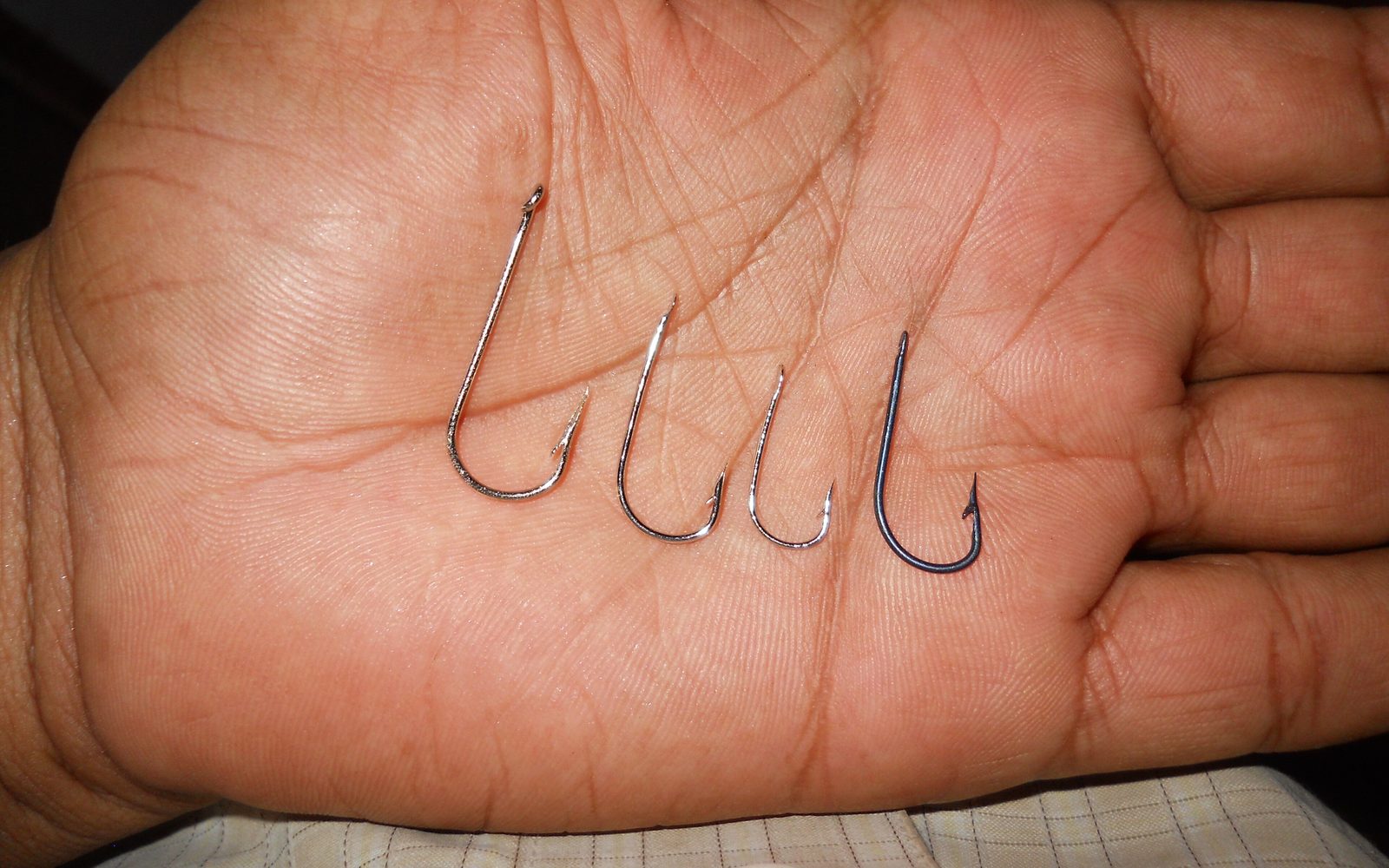
How hook sizes work
Arkansas Game & Fish says hooks are sized with numbers, and larger numbers mean a smaller hook, so a number 12 hook is much smaller than a number 2 of the same style. Once the size includes a /0, pronounced aught and standing for zero (1/0, 3/0, 5/0), the hook gets bigger as the first number increases, so a 12/0 is much larger than a 2/0.
South Carolina DNR puts the two scales together: for sizes 32 to 1 the larger the number the smaller the hook, and from 1/0 (one aught) to 19/0 the larger the number the larger the hook. Florida FWC puts it the same way, with size 32 the smallest and size 1 much larger.
How far the scale runs depends on the source. New York DEC says sizes range from tiny #22, used for tying small flies, to a giant #16/0 for shark fishing. Florida FWC’s example is an 18/0 hook for sharks against a 5/0 for grouper. New York DEC adds that hook size is determined by the length of the shank, excluding the eye.
Hook size by species
The sizes below are what state agencies recommend. They overlap because hook size also depends on the bait and rig.
| Fish | Hook size | Source and setup |
|---|---|---|
| Bluegill and bream | No. 4 to 8 | Arkansas Game & Fish. New York DEC says sizes 6 to 10 are best for panfish, and size 6 to 8 aberdeen hooks work best. Texas Parks & Wildlife uses thin-wire #6 to #10 for sunfish. |
| Crappie | No. 2 to 6 | Arkansas Game & Fish. Iowa DNR uses a small hook, No. 4, 6 or 8, with light split shot about a foot above it. |
| Trout | Size 6, 8 or 10 | Oklahoma DWC, snelled hook for winter trout fishing. |
| Walleye | Size 4 to 8 | Virginia DWR, tied to a 24 to 48 in, 8 pound test leader. |
| Bass | No. 2 to 4/0 | Arkansas Game & Fish. Texas Parks & Wildlife: #1 or #2 for bass and catfish. New York DEC's wacky rig uses a 1/0 or 2/0 circle hook; Virginia DWR's drop shot uses a size 1 or 2 hook. |
| Catfish | No. 1 to 6/0 | Arkansas Game & Fish, depending on the size of fish. Oklahoma DWC uses a 7/0 to 8/0 strong circle hook for winter catfish, and a sturdy 6/0 to 10/0 circle hook for live bluegill bait. |
| Freshwater drum | No. 2 or 4 | Arkansas Game & Fish, baitholder style. |
| Ice fishing, sunfish, perch and crappie | Size 6 to 8 | New York DEC ice table. |
| Ice fishing, trout, walleye and pickerel | Size 4 to 6 | New York DEC ice table. |
| Ice fishing, northern pike | Size 1 to 2 | New York DEC ice table. |
For the line to match each hook, see fishing line pound test.
Match the hook to the fish’s mouth
- Use a hook that is not so big that a fish can easily detect it, but not so small that it is easily swallowed (New York DEC).
- A hook that is too large may not fit in a small fish’s mouth, and one that is too small could let a larger fish bend or break it (Oklahoma DWC).
- To choose, picture the species and look at its mouth and what it likes to eat (South Carolina DNR).
- When in doubt, go smaller so the fish can take it into its mouth (Arkansas Game & Fish).
- If fish are nibbling but not getting hooked, use a smaller hook (Outdoor Alabama).
Hook styles and wire
Arkansas Game & Fish calls the J-hook, also known as the Aberdeen or round-bend hook, by far the most widely used and perhaps the most versatile style. South Carolina DNR lists popular styles as treble, Kirby, octopus, wide gap, O’Shaughnessy, baitholder, circle and weedless.
Florida FWC says a J-hook requires a strong hook set, while with circle hooks you keep tension on the line and do not set the hook.
Wire weight matters too. Thin-wire hooks are better for smaller fish and quick hooksets with less force, and crappie, bream and trout suit them. The twists, head shakes and jerks of larger fish, and the strain of heavy hooksets, can straighten light-wire hooks, while heavier wire withstands them (Arkansas Game & Fish).
The basic parts of a hook are the eye, shank, bend and barb (Oklahoma DWC), plus the sharp point (South Carolina DNR). New York DEC says any hook can be made barbless by bending the barb down with pliers.
Florida FWC says circle hooks are required when targeting reef fish species with natural bait, because they reduce mortality. Hook rules differ by state and water, so check your state’s fish and wildlife agency before you fish.
Frequently asked questions
Is a size 1 hook bigger than a size 8?
Yes. From size 32 down to size 1, a larger number is a smaller hook, so a size 1 is much bigger than a size 8 (South Carolina DNR, Arkansas Game & Fish).
What does the /0 on a hook size mean?
It is pronounced aught and stands for zero. From 1/0 upward the hook gets larger as the first number increases, so a 12/0 is much larger than a 2/0 (Arkansas Game & Fish).
What hook size for bass?
Arkansas Game & Fish lists sizes 2 to 4/0. Texas Parks & Wildlife calls #1 or #2 medium-sized hooks for bass and catfish, and New York DEC's wacky-rig bass setup uses a 1/0 or 2/0 circle hook.
What if fish nibble but I don't hook them?
Outdoor Alabama says a smaller hook should be used. Arkansas Game & Fish says that when in doubt, choose the smaller hook so the fish can take it into its mouth.
Sources
- Getting to the point on fishing hooks, Arkansas Game & Fish Commission
- South Carolina fishing guide (PDF), South Carolina DNR
- Learn-to-fish guide: fishing basics (PDF), New York State DEC
- Fishing basics, Florida Fish and Wildlife Conservation Commission
- Chapter 2: Fishing tackle and supplies, Oklahoma Department of Wildlife Conservation
- Basic fishing tips (PDF), Outdoor Alabama, Alabama Department of Conservation and Natural Resources
- Panfish, New York State DEC
- Crappie, Iowa DNR
- Fishing basics handbook (PDF), Texas Parks & Wildlife Department
- Winter fishing tips, Oklahoma Department of Wildlife Conservation
- Catfish angler guide: top tips and area highlights, Oklahoma Department of Wildlife Conservation
- Ice fishing (I FISH NY lesson plan, PDF), New York State DEC
- Seventeen tips for catching walleyes, Virginia Department of Wildlife Resources
- Drumming up spring fishing excitement, Arkansas Game & Fish Commission
- Wacky rig for bass (I FISH NY lesson plan, PDF), New York State DEC
- Drop shotting in Virginia, Virginia Department of Wildlife Resources