

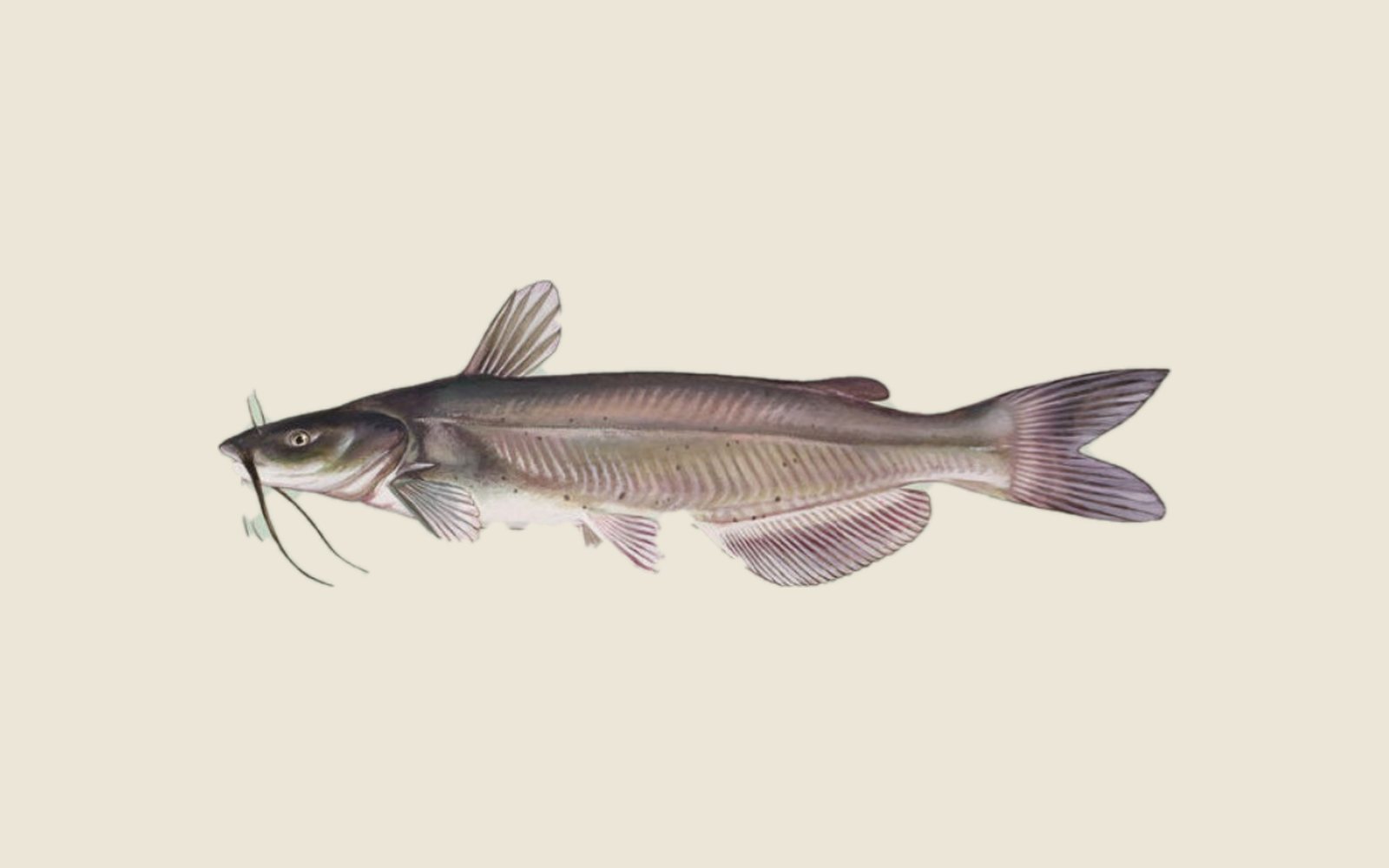
Channel catfish
- Typical size
- 12–32 in, 1–15 lb common (Missouri); usually under 5 lb (Florida)
- Record (IGFA)
- 58 lb 0 oz (IGFA all-tackle)
- Water temp
- Spawn at about 75 °F
- Best months
- Missouri: late May–Jul (spawn) · Oklahoma: late Apr–May (pre-spawn, dam riprap) · Iowa: Jun–Aug (pan-size fish on prepared bait)
- Top baits
- Chicken liver, Nightcrawlers, Cut bait, Stink or punch bait
- Rig
- Slip sinker rig (Iowa)
- Line (lb test)
- 10 lb test (Iowa)
Seasons, size and bag limits and licenses vary by state and water. Check your state agency, for example the Oklahoma Department of Wildlife Conservation
How to identify a channel catfish
A deeply forked tail is a channel catfish mark that only the blue catfish shares (Texas). The upper jaw projects beyond the lower, and Missouri says scattered dark spots are common, though they can be absent on the smallest young and on large adults. Breeding males turn deep blue-black with a swollen, knobby head (Missouri).
Three marks separate it from a blue catfish:
- Anal fin rays: 24 to 29 on a channel, 30 or more on a blue (Texas).
- Anal fin edge: rounded on a channel, straight on a blue (Missouri).
- Head and back: a channel has a gently sloping back and a curved head profile, and a blue has a straight, wedge-shaped head (Missouri, Alabama).
Oklahoma adds that a flathead is darker and has no forked tail. See the blue catfish page for the other half of the comparison.
Where channel catfish live
Channel cats use many kinds of water: rivers, reservoirs, streams, backwaters, swamps and oxbow lakes (Alabama). Texas adds large streams with low or moderate current.
- Adults sit in larger pools, deep water and cover (Missouri), near cover in pools and deep holes (Oklahoma). Oklahoma also names dam riprap and creek channels.
- Young fish use riffles and shallow pools (Missouri) and tolerate current (Oklahoma).
- Big rivers: Missouri says to look for slow current between dikes, backwaters and side channels, shallower than where blue catfish hold.
They are omnivores that eat insects, mollusks, crustaceans, fish and some plant material (Texas). Past 16 inches, fish alive or dead make up most of the diet (Iowa). Missouri says channel catfish feed at night in shallows and riffles, finding food by taste, smell and touch with their barbels. Arkansas says a channel catfish has 140 scent-sensing folds, against 10 or so on a largemouth bass.
When to catch channel catfish
Channel catfish can be caught any time, and Oklahoma says they are more active in low light and overnight. Florida names the hours just before dusk and night. Missouri fish rest in deep water and cover by day and move into riffles and shallows at night.
| State | J | F | M | A | M | J | J | A | S | O | N | D |
|---|---|---|---|---|---|---|---|---|---|---|---|---|
| Missouri | Not in season: January | Not in season: February | Not in season: March | Not in season: April | In season: May | In season: June | In season: July | Not in season: August | Not in season: September | Not in season: October | Not in season: November | Not in season: December |
| Oklahoma | Not in season: January | Not in season: February | Not in season: March | Not in season: April | In season: May | In season: June | Not in season: July | Not in season: August | Not in season: September | Not in season: October | Not in season: November | Not in season: December |
| Alabama | Not in season: January | Not in season: February | Not in season: March | Not in season: April | In season: May | In season: June | In season: July | In season: August | Not in season: September | Not in season: October | Not in season: November | Not in season: December |
| Washington | Not in season: January | Not in season: February | Not in season: March | Not in season: April | Not in season: May | In season: June | In season: July | Not in season: August | Not in season: September | Not in season: October | Not in season: November | Not in season: December |
Texas also gives 75°F for late spring and early summer. Seasonal notes:
- Late winter and spring: Iowa suggests cut bait or dead minnows after ice-out. Iowa says feeding picks up after 40°F, and Oklahoma anglers fish a worm and bobber at dam riprap in late April and May, before the spawn. Missouri fishes riprap shorelines in late May and June at 65°F.
- Summer: Iowa says prepared baits work from 70°F and are best for pan-size fish from June through August.
- High water: Iowa says they are easily caught in high flows from spring to early fall.
- Fall and winter: Washington reports a pickup in early fall that then slows, with winter difficult. Iowa says catfish can be caught under ice.
How to catch channel catfish
Baits state agencies name
- Texas: liver, worms, grasshoppers, shrimp, chicken, cheese and stinkbait.
- Washington: worms, liver, hot dogs, shrimp, cut bait from oily fish, and stink or dough baits. Strong-smelling baits work because of the catfish’s sense of smell, and Washington says to fish them on or near the bottom.
- Florida: chicken liver or gizzards, shrimp, cut mullet, stinkbait, earthworms and clams.
- Missouri: bait-dipped rubber worms, nightcrawlers, chicken liver, grasshoppers, crayfish and small fish.
- Alabama: cheese, chicken, dough balls, redworms and cut bait.
- Iowa: nightcrawlers, leeches, chicken blood, liver or guts, crawdads, grasshoppers, water dogs, minnows, cut bait and stink baits. For larger catfish Iowa uses big baits such as dead bluegill, live chubs, water dogs, crayfish and frogs.
- Oklahoma: channel cats take non-live, non-natural baits more than flathead or blue do. It lists punch bait, stink bait and cut bait on the bottom, and chicken liver, live worms, hot dogs and dough bait at American Horse Lake.
- Arkansas: shad, small bream, and chunks of carpsucker or skipjack, plus catalpa worms and nightcrawlers. Tough-skinned cut carp or buffalo stays on the hook.
Rigs, hooks and line
Iowa DNR uses a slip sinker rig with 10 pound test, and circle hooks for live or cut bait. Florida fishes a #2 to #4 hook with heavy split shot on the bottom. Oklahoma uses a medium to extra-heavy rod with 10 to 80 pound line across all catfish species. Rig diagrams are in catfish rigs, and the full bait list is in catfish bait.
Channel catfish size and the IGFA record
Missouri lists 12 to 32 inches and 1 to 15 pounds as common, with 45 pounds uncommon. Washington’s stocked fish average 16 to 24 inches at 2 to 5 years, and some pass 30 inches and 30 pounds. Florida says fish may exceed 40 pounds but are typically under 5 pounds, and Oklahoma says they rarely exceed 50 pounds.
The IGFA all-tackle record is 58 pounds 0 ounces (26.3 kg), and Texas calls 58 pounds the North American record. Iowa’s state record is 38 pounds 2 ounces from the Missouri River in June 2005.
Rules
Limits vary by state. Check the agency where you fish, such as the Oklahoma Department of Wildlife Conservation or the Texas Parks and Wildlife Department.
Frequently asked questions
How can I tell a channel catfish from a blue catfish?
Count anal fin rays and look at the fin edge. Texas gives 24 to 29 rays for channel and 30 or more for blue. Missouri says the channel's anal fin edge is rounded and the blue's is straight.
How big do channel catfish get?
Missouri lists 12 to 32 inches and 1 to 15 pounds as common. Florida says typical fish are under 5 pounds. The IGFA all-tackle record is 58 pounds.
What is the best time of day to catch channel catfish?
Low light and night. Oklahoma says channel catfish are more active in low light and overnight but can be caught any time, and Florida names the period just before dusk and night.
What bait do channel catfish take?
State agencies name chicken liver, nightcrawlers, cut bait, shrimp, hot dogs, dough bait and stink or punch bait. Arkansas says scent is the secret ingredient.
What line and hook do you use for channel catfish?
Iowa DNR suggests 10 pound test and a slip sinker rig, with circle hooks for live or cut bait. Florida uses a #2 to #4 hook with heavy split shot on the bottom.
Sources
- Channel catfish, Texas Parks and Wildlife Department
- Channel catfish field guide, Missouri Department of Conservation
- Catfish tips for fishing, Missouri Department of Conservation
- Big river catfishing, Missouri Department of Conservation
- Channel catfish, Outdoor Alabama (ADCNR)
- Channel catfish (Ictalurus punctatus), Washington Department of Fish & Wildlife
- Catfish angler guide: top tips and area highlights, Oklahoma Department of Wildlife Conservation
- Channel catfish field guide, Oklahoma Department of Wildlife Conservation
- Catfish, Florida Fish and Wildlife Conservation Commission
- Channel catfish, Iowa DNR
- Stinky stuff: catfish baits that reek of success, Arkansas Game & Fish Commission
- Channel catfish, Game Fish Database, International Game Fish Association