

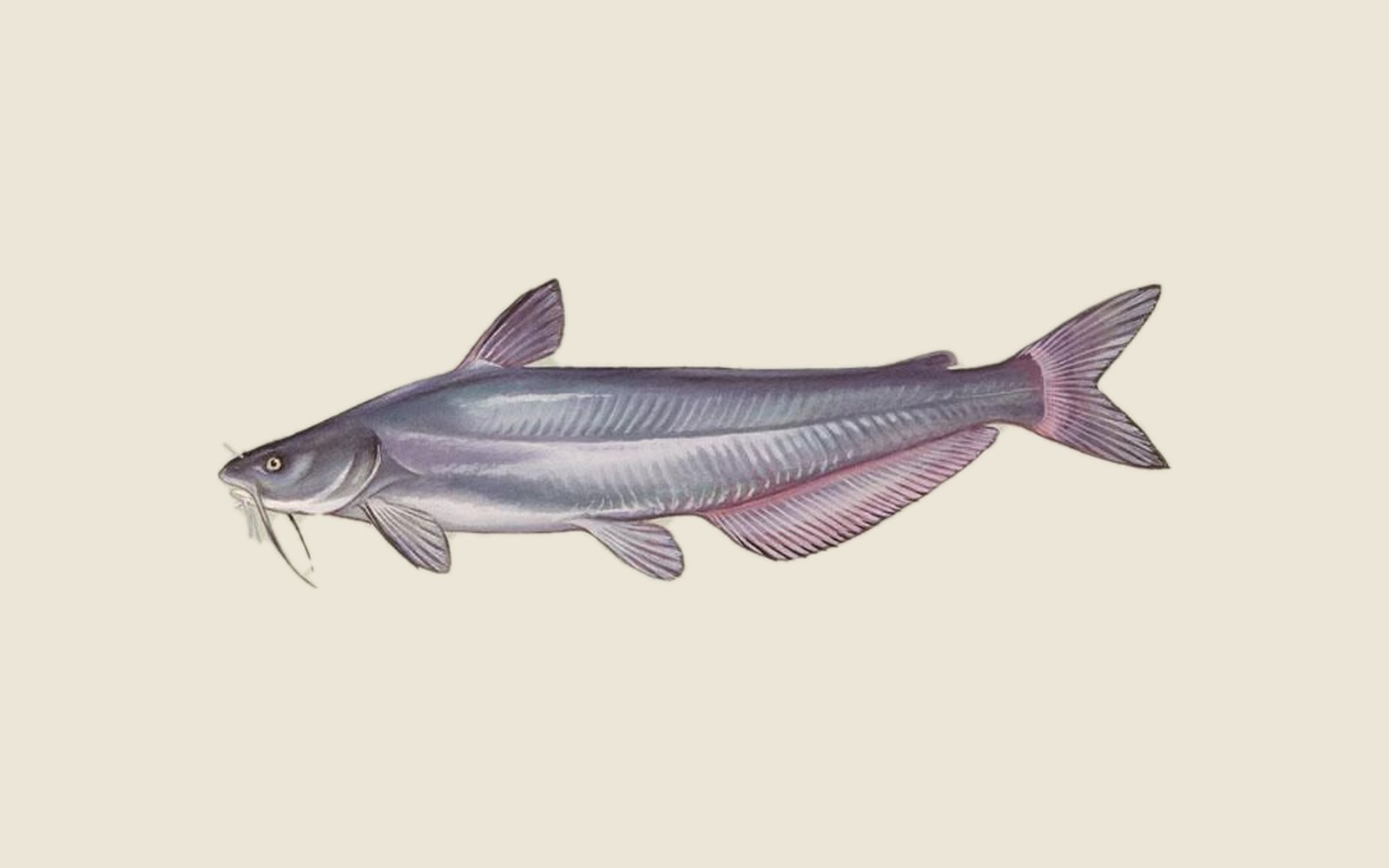
Blue catfish
- Typical size
- 3–40 lb, 20–44 in (Missouri); commonly 20–40 lb (Texas)
- Record (IGFA)
- 143 lb 0 oz (IGFA all-tackle)
- Water temp
- Spawn at 70–75 °F (Iowa)
- Best months
- Texas: Feb–Apr (guide quoted by TPWD) · Missouri (Mississippi River tailwaters): early spring at 50–60 °F
- Top baits
- Cut gizzard shad or skipjack herring, Fresh cut menhaden, Live sunfish or goldfish
- Rig
- Cut shad on a circle hook off the bottom or under a float (Oklahoma)
- Line (lb test)
- 30–50 lb mono, 6/0–8/0 circle hooks (Missouri)
Seasons, size and bag limits and licenses vary by state and water. Check your state agency, for example the Texas Parks and Wildlife Department
How to identify a blue catfish
The anal fin is the surest mark. A blue catfish has a straight-edged anal fin with 30 to 35 rays (Missouri, Texas), and Alabama gives 30 or more soft rays with a straight margin. USGS puts it simply: a straight anal fin edge means blue, and a curved edge means channel.
| Feature | Blue catfish | Channel catfish |
|---|---|---|
| Anal fin edge | Straight (Missouri, USGS) | Rounded or curved (Missouri, USGS) |
| Anal fin rays | 30 or more (Texas, Alabama) | 24 to 29 (Texas) |
| Head and back | Steep, straight back and a wedge-shaped head (Missouri) | Gently sloping back and a less wedge-shaped head (Missouri) |
| Spots | Never has dark spots (Missouri); only Rio Grande fish are spotted (Texas) | Scattered dark spots, often absent on the smallest young and on large adults (Missouri) |
| Colour | Slate blue (Texas) | Varies; breeding males deep blue-black (Missouri) |
| Where | Big rivers, swift chutes and current (Missouri) | Large streams with low or moderate current (Texas) |
Both species have a deeply forked tail. For the other half of the comparison see channel catfish.
Where blue catfish live
Blues are fish of big rivers. Missouri describes big rivers, swift chutes and current over silt-free sand, gravel and rubble. Maryland says large rivers, deep channels, swift current and sandy bottom, and Oklahoma large rivers and reservoirs with sand, gravel or rock bottoms.
- Tailwaters: Alabama says the largest fish are in tailwaters below dams.
- Big-river spots: Missouri names current near dike tips, below dams and in the main channel.
- Seasonal movement: Texas says blue catfish move upstream in summer and downstream in winter.
They are bottom feeders that eat fish, insects, crayfish, clams and mussels (Missouri). Texas says fish and large invertebrates above 8 inches, and Oklahoma says shad is preferred.
When to catch blue catfish
Blues are a cool-water target as much as a summer one.
| State | J | F | M | A | M | J | J | A | S | O | N | D |
|---|---|---|---|---|---|---|---|---|---|---|---|---|
| Texas | Not in season: January | In season: February | In season: March | In season: April | Not in season: May | Not in season: June | Not in season: July | Not in season: August | Not in season: September | Not in season: October | Not in season: November | Not in season: December |
| Missouri (Mississippi River) | Not in season: January | Not in season: February | In season: March | In season: April | Not in season: May | Not in season: June | Not in season: July | Not in season: August | Not in season: September | Not in season: October | Not in season: November | Not in season: December |
| Oklahoma | In season: January | In season: February | Not in season: March | Not in season: April | Not in season: May | Not in season: June | Not in season: July | Not in season: August | Not in season: September | Not in season: October | Not in season: November | In season: December |
| Maryland (tidal rivers) | In season: January | In season: February | Not in season: March | Not in season: April | Not in season: May | Not in season: June | Not in season: July | Not in season: August | Not in season: September | Not in season: October | Not in season: November | In season: December |
Spawning runs about May and June in Missouri, late May into July for catfish generally in Oklahoma, and at 70 to 75°F from June to early July in Iowa. Missouri adds that blues travel in groups and sometimes feed on shallow flats in the heat of the day.
How to catch blue catfish
Baits
- Missouri: many anglers prefer gizzard shad and skipjack herring, which are said to release oil that attracts catfish. It also uses live or dead sunfish and goldfish.
- Maryland: fresh cut menhaden, gizzard shad, white perch, bluegill and eel. Live bait suits fish over 60 pounds, and anglers chum with ground menhaden. Maryland’s general list also includes shrimp, chicken liver and processed bait.
- Oklahoma: live or dead bait and crankbaits, with cut shad on a circle hook off the bottom or under a float.
- Texas: a jug-line angler quoted by TPWD uses shad, chicken liver or worms for channels and blues.
Hooks, rod and line
Missouri recommends 6/0 to 8/0 circle hooks on a 7 to 10 foot medium-heavy or heavy rod with 30 to 50 pound monofilament. It notes that blues of 20 to 50 pounds are common in some waters, so the gear is heavy. Rig diagrams are in catfish rigs, and more baits are listed in catfish bait.
Blue catfish size and record weights
Missouri lists 20 to 44 inches and 3 to 40 pounds, and Texas says commonly 20 to 40 pounds with over 100 pounds possible. Iowa says adults of 20 to 25 pounds are common, while Alabama river surveys found most fish at 10 pounds or less and 30 to 50 pounds infrequent. USGS gives a maximum length of 165 cm and 40 to 50 kg.
Record numbers depend on who keeps the list:
- IGFA all-tackle: 143 pounds 0 ounces (64.86 kg).
- Maryland DNR: a 124 pound sportfishing record, a fish from Illinois.
- Texas: a rod-and-reel record of 121.5 pounds.
- Missouri: recent record weights in the 115 to 130 pound range.
- State records: Florida 69.5 pounds from the Choctawhatchee River in 2015, and Maryland 84 pounds.
Rules
Limits vary by state and water. Check the agency where you fish, such as the Texas Parks and Wildlife Department or the Maryland Department of Natural Resources.
Frequently asked questions
What is the world record blue catfish?
The IGFA Game Fish Database lists 143 pounds 0 ounces (64.86 kg) as the all-tackle record. Maryland DNR gives a 124 pound sportfishing record from Illinois, so check which list a record comes from.
How can I tell a blue catfish from a channel catfish?
Look at the anal fin. A blue has a straight edge and 30 to 35 rays, and a channel has a rounded edge and 24 to 29 rays. Blues also have a steep straight back and a wedge-shaped head, and Missouri says they never have dark spots.
Where are the biggest blue catfish?
In big rivers with current. Missouri points to current near dike tips, below dams and in the main channel, and Alabama says the largest fish are in tailwaters below dams.
What is the best bait for blue catfish?
Fresh cut fish. Missouri says many anglers prefer gizzard shad and skipjack herring, which are said to release attractive oil, and Maryland names fresh cut menhaden, gizzard shad, white perch, bluegill and eel.
What hook size do you use for big blue catfish?
Missouri names 6/0 to 8/0 circle hooks on a 7 to 10 foot medium-heavy or heavy rod with 30 to 50 pound monofilament.
Sources
- Blue catfish field guide, Missouri Department of Conservation
- Big river catfishing, Missouri Department of Conservation
- Catfish tips for fishing, Missouri Department of Conservation
- Blue catfish, Texas Parks and Wildlife Department
- Heart of Texas cats, Texas Parks and Wildlife Department
- Blue catfish (Ictalurus furcatus) fact sheet, USGS Nonindigenous Aquatic Species
- Blue catfish, Outdoor Alabama (ADCNR)
- Blue catfish fish facts, Maryland Department of Natural Resources
- Fishing for blue catfish, Maryland Department of Natural Resources
- Blue catfish, Iowa DNR
- Catfish angler guide: top tips and area highlights, Oklahoma Department of Wildlife Conservation
- Catfish, Florida Fish and Wildlife Conservation Commission
- Blue catfish, Game Fish Database, International Game Fish Association