
Carp
- Typical size
- About 30 in, 10–15 lb; up to 60 lb (Maryland)
- Record (IGFA)
- 75 lb 11 oz, common carp (IGFA all-tackle)
- Water temp
- Spawn at 48–90 °F (Texas)
- Best months
- Maryland: late Apr–Jun (spawn) · Iowa: mid-Apr–Jun (spawn) · Texas: Mar–Sep (spawn)
- Top baits
- Sweet corn, Dough balls, Worms, Boilies
- Rig
- Sliding sinker, least weight possible, no bobber
- Line (lb test)
- 12–15 lb (Washington, Texas)
Seasons, size and bag limits and licenses vary by state and water. Check your state agency, for example the Maryland Department of Natural Resources
How to identify a carp
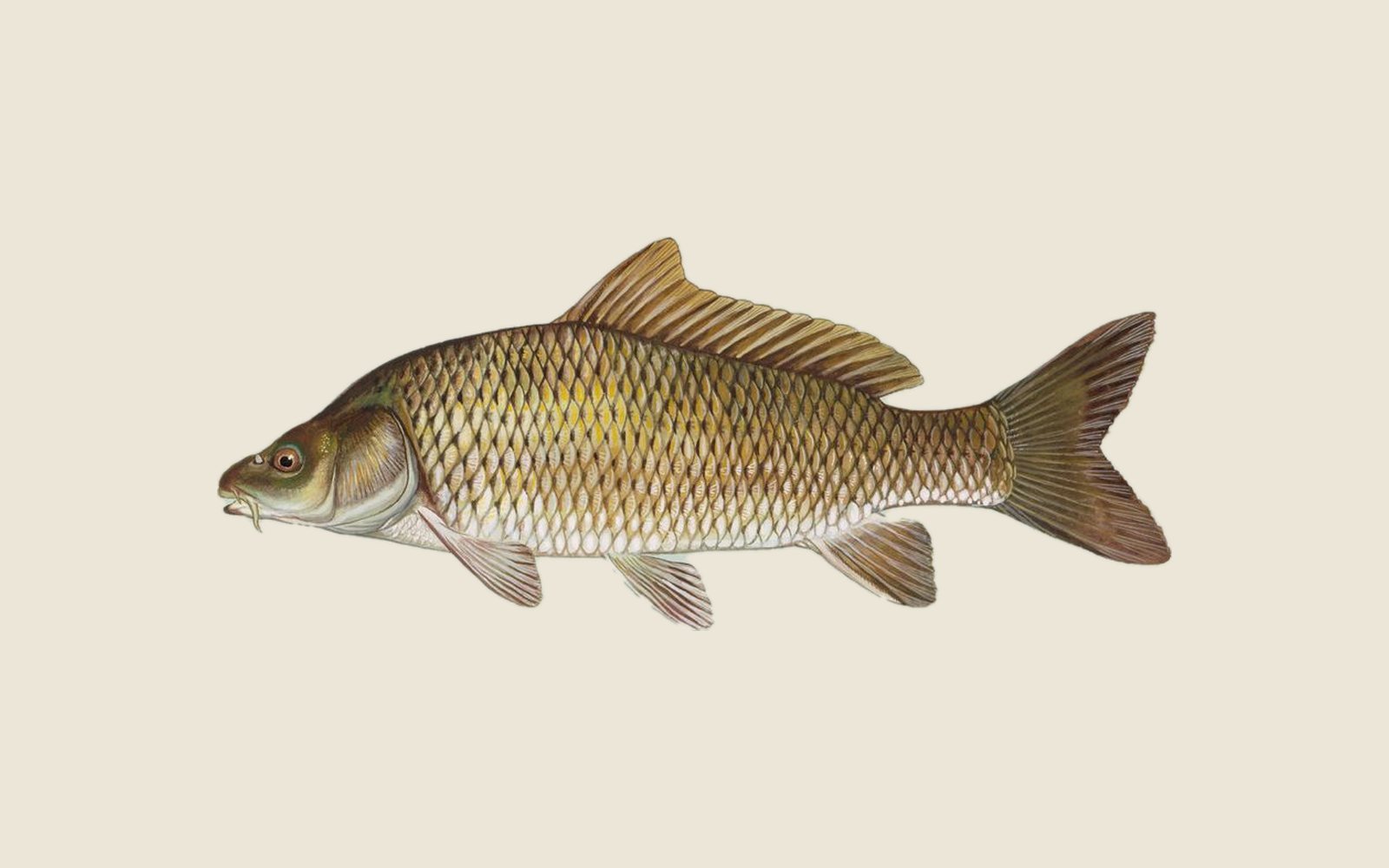
Common carp have large scales and a pair of barbels on each side of the mouth, according to Washington, Maryland and Texas. USGS lists the barbels as one per side, so count them as a guide and not a test. Other marks agencies name:
- Spines: a stout, serrated spine at the front of the dorsal and anal fins (Washington, Iowa).
- Colour and tail: light gold to dark brown with reddish fins (USGS), and a forked, often reddish tail (Maryland).
- Variants: mirror, leather and half-scaled carp occur (Washington). Texas says mirror, Israeli and koi carp are the same species.
- Grass carp: these lack the sucker-like mouth and the barbels (Washington).
USGS lists the common carp as native to Eurasia, and Maryland says it came from the Caspian Sea region and east Asia.
Where carp live
Carp are tolerant fish. Maryland finds them in large, slow or still water with a soft bottom, in shallow backwaters and along shorelines. Texas says they tolerate turbid water, oxygen as low as 3 ppm and temperatures from 34 to 106°F, and Iowa describes warm, still or sluggish water.
Washington looks for deep holes and driftwood piles in rivers and shallow, snag-free areas in lakes. Carp are omnivores that prefer the bottom (Texas). They eat snails, worms, midge larvae, crustaceans and algae (New York), and insects, small mollusks and plants (Iowa).
When to catch carp
Washington says carp feed all day in cool weather and in the early morning and evening in summer heat. Iowa says they feed in newly flooded areas, so use worms or dough balls when a river is rising.
| State | J | F | M | A | M | J | J | A | S | O | N | D |
|---|---|---|---|---|---|---|---|---|---|---|---|---|
| Maryland | Not in season: January | Not in season: February | Not in season: March | In season: April | In season: May | In season: June | Not in season: July | Not in season: August | Not in season: September | Not in season: October | Not in season: November | Not in season: December |
| Iowa | Not in season: January | Not in season: February | Not in season: March | In season: April | In season: May | In season: June | Not in season: July | Not in season: August | Not in season: September | Not in season: October | Not in season: November | Not in season: December |
| Texas | Not in season: January | Not in season: February | In season: March | In season: April | In season: May | In season: June | In season: July | In season: August | In season: September | Not in season: October | Not in season: November | Not in season: December |
How to catch carp
Baits
- Washington: doughballs, corn and worms.
- Missouri: dough balls, whole kernel corn and worms.
- New York: bread dough, canned corn and commercial baits.
- Maryland: dough balls, worms, crayfish tails and canned corn.
- Texas: sweet corn, flavoured dough balls and worms, plus boilies. Texas publishes homemade bait recipes, and it chums with corn, maize, range cubes, rotten potatoes or boilies.
Hooks, weight and line
Carp reject baits that offer resistance, Washington says, so use the least amount of weight possible and no bobbers. Fish a slack line in lakes and a tight line in streams. Washington uses a size 6 or 8 short-shank single hook, or size 8 to 12 trebles, and prefers an open-faced spinning reel holding 100 to 150 yards of 12 pound monofilament with a good drag.
Texas builds a beginner kit around a 7 foot medium rod, 15 pound line, a 1/4 to 1/2 ounce sliding sinker and size 4 to 8 hooks. It says to set the drag low.
Carp size and records
Maryland says a typical carp is about 30 inches and 10 to 15 pounds, with fish up to 60 pounds. In southeastern New York the average is 5 to 10 pounds, with 15 to 20 pounds sometimes, and Iowa says adults reach 50 pounds or more. Washington gives a maximum of 47 inches and over 88 pounds.
The IGFA all-tackle record for common carp is 75 pounds 11 ounces (34.35 kg). State records include New York’s 50.25 pounds from Tomhannock Reservoir in 1995 and Texas’s 43.13 pounds from Lady Bird Lake in 2006.
Rules
Limits vary by state. Check the agency where you fish, such as the Maryland Department of Natural Resources or the Washington Department of Fish & Wildlife.
Frequently asked questions
What is the best bait for carp?
Sweet corn, dough balls and worms. Washington, Missouri, Maryland and Texas all list corn, dough balls or worms, and Texas adds flavoured dough balls and boilies.
What hook size do you use for carp?
Washington uses a size 6 or 8 short-shank single hook, or size 8 to 12 trebles. Texas suggests size 4 to 8 hooks for a beginner kit.
Should I use a bobber for carp?
No. Washington says carp reject baits that offer resistance, so use the least weight possible and no bobbers. It fishes a slack line in lakes and a tight line in streams.
When do carp spawn?
Maryland gives late April through June in shallow weedy bays, and Iowa mid-April through June. Texas lists March through September at 48 to 90°F.
How big do carp get?
Maryland says about 30 inches and 10 to 15 pounds is typical, with fish up to 60 pounds. The IGFA common carp record is 75 pounds 11 ounces.
Sources
- Common carp (Cyprinus carpio carpio), Washington Department of Fish & Wildlife
- Common carp fish facts, Maryland Department of Natural Resources
- Cyprinus carpio fact sheet, USGS Nonindigenous Aquatic Species
- Carp fishing brochure, Texas Parks and Wildlife Department
- Carp baits, Texas Parks and Wildlife Department
- Common carp, Iowa DNR
- Region 3 carp fishing, New York State DEC
- Carp, Missouri Department of Conservation
- Common carp, Game Fish Database, International Game Fish Association