

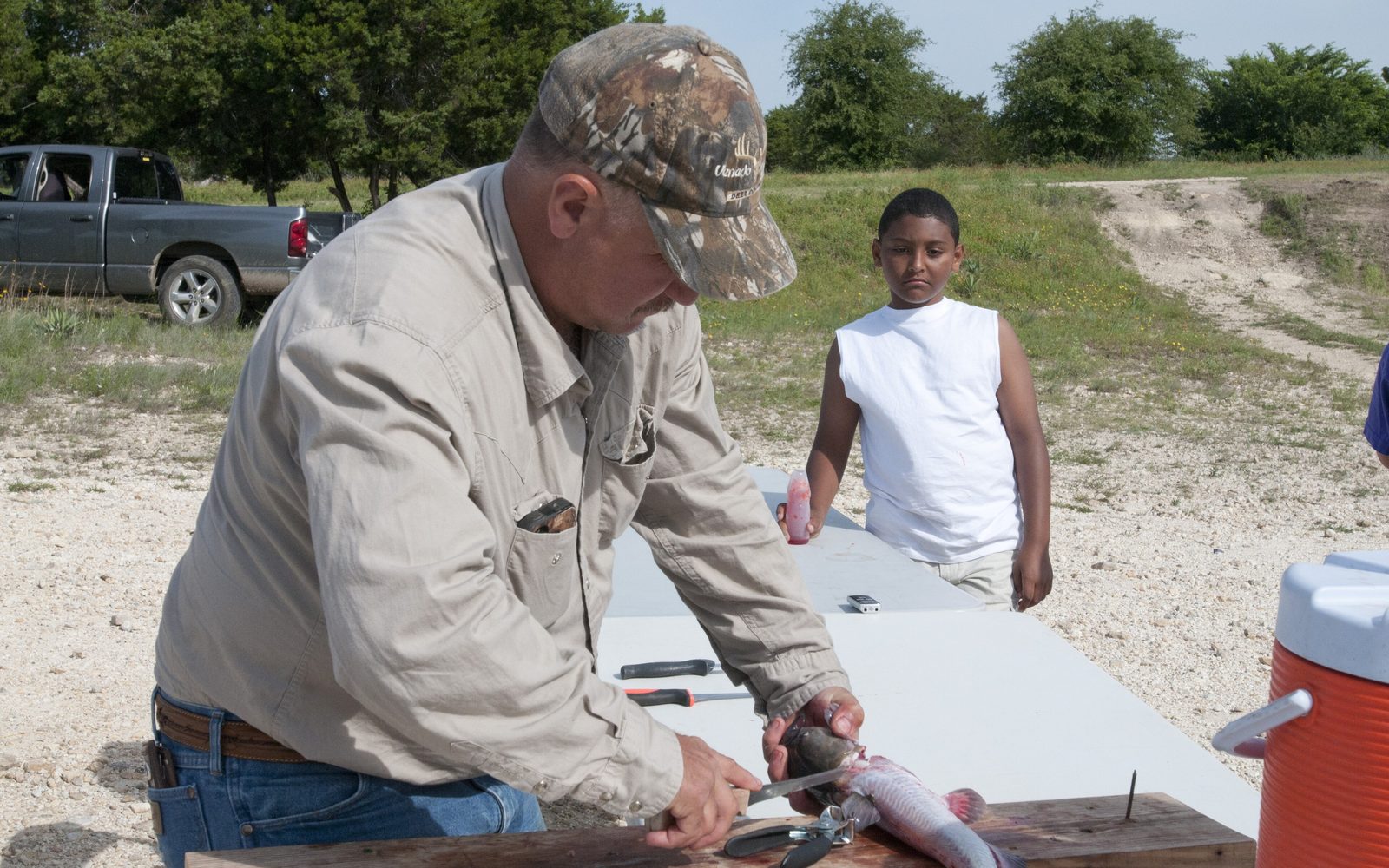
Utah DWR says catfish have bony, barbed spines on the front pectoral fins that are an anti-predator adaptation and can be locked into place. South Carolina DNR says to be very careful to avoid the spines in the pectoral fins and the dorsal fin. Outdoor Alabama removes the spines first to prevent puncture of a hand or finger.
What you need
Utah DWR’s list for catfish:
- A large bucket or fish stringer
- A cooler with plenty of ice
- A very sharp, flexible-bladed knife, such as a 6 to 8 inch fillet knife
- Game shears or scissors
- Catfish skinning pliers, or needle-nose pliers
- A fish fillet glove or fish-handling rag
- A cutting board with a clamp (a fillet board)
Skin and fillet a catfish
Utah DWR says you can fillet and then skin a catfish like other fish, but many anglers find it easier to remove the skin while the fish is whole.
- Keep it cold, and bleed it if you like. Utah DWR says storing the fish on ice is key to preserving the meat, especially in summer heat. Bleeding is optional: let the fish bleed out for about 10 minutes, then move it to a cooler with plenty of ice. Outdoor Alabama notes fish die quickly on stringers in warm weather.
- Score the skin. Use a very sharp 6 to 8 inch fillet knife to score the skin with shallow cuts on both sides of the head and along the spine all the way to the tail.
- Break off the barbels and pectoral fins. With pliers, break off the long barbels and the pectoral fins near the gills so the fish can lie flat on the board.
- Pull off the skin. Starting at the scored cut next to the head, use the catfish pliers to pull the skin off, working toward the tail.
- Remove the head and guts, or fillet. For a dressed fish, South Carolina DNR says to cut the head completely off after skinning and remove the innards. Outdoor Alabama says to break or cut the head away from the backbone and remove the viscera. To fillet instead, go to step 6.
- Fillet along the spine. Utah DWR recommends the double-fillet technique. Working from tail to head, keep the knife parallel to the cutting board and cut along the spine to release the fillet. To free it from the rib cage, use your thumb to make a wedge between the spine and the meat and slide the knife against the ribs to peel the fillet away.
- Trim each fillet. Remove the lateral line, any fat and other connective tissue. A thin sheen of membrane on the skin side can taste strong and make the fish curl when cooked, so cut it away (Utah DWR).
The general fillet routine is in how to fillet a fish.
Other skinning methods
- South Carolina DNR. Make your first cut behind the head at the pectoral fin on one side, up and over to the other pectoral fin. Slice down the backbone on one side of the dorsal fin and again on the other side to connect the cut. Use pliers to pull the skin back from the body while holding the head with your other hand, then cut off the head and remove the innards.
- Outdoor Alabama. Remove the spines, cut through the skin around the head and pectoral fins without penetrating the body cavity, then pull the skin from the head toward the tail with pliers.
- Wisconsin DNR, catfish. Make an incision around the head and down the belly, grab the skin with pliers and pull it down toward the tail.
- Wisconsin DNR, bullheads. Cut into the back at an angle toward the head from directly behind the dorsal spine, down to the backbone, without severing it. Grasp the body between thumb and forefinger and pull in opposite directions, and the head, skin and entrails come away in one operation, leaving edible flesh with the backbone attached.
Why cut away the lateral line
South Carolina DNR says to cut away all the dark red meat along the lateral line because it often has a strong flavor. Utah DWR adds that if there are contaminants in the water you fish, they typically settle in the non-meat tissues of the fish, including the fat and the nervous and connective tissue.
Cooking tip
Utah DWR says soaking fillets in whole milk or buttermilk for 30 minutes to 1 hour before cooking can help remove any lingering fishy taste, and that cutting fillets into smaller pieces for frying helps them cook evenly in the oil. For the basic cleaning methods used on other fish, see how to clean a fish. Catching them? The channel catfish guide covers size, baits and best months.
Frequently asked questions
Do you scale a catfish?
No. Catfish have skin that must be removed, and South Carolina DNR says catfish and bullheads must be skinned instead of scaled. Wisconsin DNR says catfish skin can be removed easily with pliers.
Do I have to bleed a catfish?
No. Utah DWR says bleeding the fish right after you catch it is not required, but it preserves the quality of the meat and many anglers believe it improves the taste. If you bleed it, leave it for about 10 minutes, then move it to a cooler with plenty of ice.
What is the dark meat on a catfish fillet?
It is the dark red meat along the lateral line, which often has a strong flavor, and South Carolina DNR says to cut all of it away when filleting. Utah DWR also removes the lateral line, fat and connective tissue from each fillet.
How do you get the fishy taste out of catfish?
Utah DWR says soaking fillets in whole milk or buttermilk for 30 minutes to 1 hour before cooking can help remove any lingering fishy taste.
Sources
- How to clean and prepare catfish, Utah Division of Wildlife Resources
- South Carolina fishing guide (PDF), South Carolina DNR
- Basic fishing tips (PDF), Outdoor Alabama, Alabama Department of Conservation and Natural Resources
- Catfish (PDF), Wisconsin DNR
- How to skin bullheads (PDF), Wisconsin DNR