

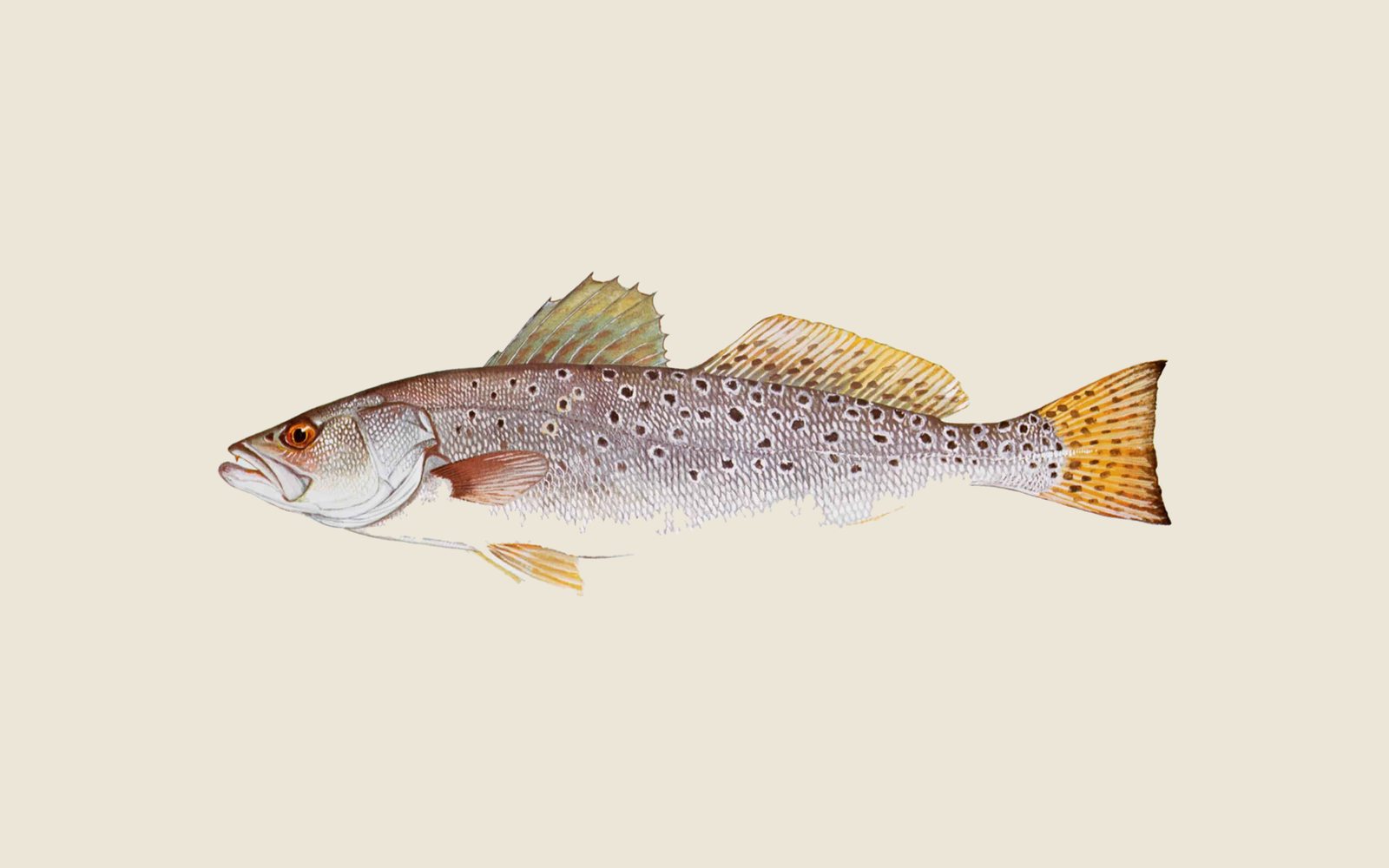
Speckled trout
Also called Spotted seatrout, Speck, Southern spotted weakfish (North Carolina)
- Typical size
- 15–25 in, 2–4 lb (North Carolina); to 40 in, 12 lb
- Record (IGFA)
- 17 lb 7 oz, spotted seatrout (IGFA all-tackle)
- Best months
- Texas: late spring–early fall (spawn) · North Carolina: late Apr–early Oct (spawn) · Alabama: May–Sep (spawn)
- Top baits
- Live shrimp, Live mullet or pinfish, Soft jigs, Spoons, Poppers
- Rig
- Popping cork rig, or free-shrimped (Texas)
Seasons, size and bag limits and licenses vary by state and water. Check your state agency, for example the Texas Parks and Wildlife Department
How to identify a speckled trout
North Carolina describes a slender fish with a blue-gray back, round black spots extending onto the second dorsal fin and tail, and two canine-like teeth. Texas adds a gray or green back with round spots on the back, fins and tail, an unscaled soft dorsal fin and canine teeth. Alabama says the small spots run in oblique rows and the canines are large. South Carolina also notes the soft dorsal fin has no scales.
Florida points out the lookalike: weakfish have wavy lines, not spots.
Where speckled trout live
Speckled trout are inshore fish. North Carolina lists rivers, estuaries and shallow coastal waters with sandy bottoms, seagrass and salt marsh. Texas says shallow bays and estuaries with oyster and seagrass beds, and Alabama large shallow grassy flats.
Cold pushes them deeper. Alabama names channels and deep pools as winter refuge, South Carolina says they overwinter in deeper channels and that cold can kill them, and North Carolina calls them cold-sensitive, with northern populations migrating south in winter. Florida says they sit in deeper, still water in cold months.
They eat by size: crustaceans first, then shrimp and small fish, then mullet, pinfish, pigfish and menhaden (Texas). North Carolina lists shrimp, crabs, mullet and menhaden and says they feed on shoals with an incoming tide. South Carolina says fish make up more of the diet as trout grow.
When to catch speckled trout
Texas gives the clearest seasonal pattern:
- Spring and summer: shallow grass beds.
- Warm weather days: shallows in the early morning and late evening, deeper water at midday.
- Fall: deeper bay water and the Gulf, returning to the shallows in spring.
- Very cold weather: deep rivers, harbors and channels.
Texas also says to look for feeding gulls in summer and fall, and that large trout feed infrequently. Alabama notes fall runs of redfish, speckled trout and flounder in the Mobile Delta.
| State | J | F | M | A | M | J | J | A | S | O | N | D |
|---|---|---|---|---|---|---|---|---|---|---|---|---|
| Florida (statewide) | Not in season: January | Not in season: February | In season: March | In season: April | In season: May | In season: June | In season: July | In season: August | In season: September | In season: October | In season: November | Not in season: December |
| Florida (Tampa Bay) | Not in season: January | Not in season: February | In season: March | In season: April | In season: May | In season: June | In season: July | In season: August | In season: September | Not in season: October | Not in season: November | Not in season: December |
| Texas | Not in season: January | Not in season: February | Not in season: March | Not in season: April | In season: May | In season: June | In season: July | In season: August | In season: September | Not in season: October | Not in season: November | Not in season: December |
| North Carolina | Not in season: January | Not in season: February | Not in season: March | In season: April | In season: May | In season: June | In season: July | In season: August | In season: September | In season: October | Not in season: November | Not in season: December |
| South Carolina | Not in season: January | Not in season: February | Not in season: March | In season: April | In season: May | In season: June | In season: July | In season: August | In season: September | Not in season: October | Not in season: November | Not in season: December |
| Alabama | Not in season: January | Not in season: February | Not in season: March | Not in season: April | In season: May | In season: June | In season: July | In season: August | In season: September | Not in season: October | Not in season: November | Not in season: December |
South Carolina’s report says spawning is delayed to May in cool springs and starts in late April in warm ones.
How to catch speckled trout
Live bait
Live shrimp is best in Texas, followed by live mullet or pinfish and dead shrimp. Florida free-lines live shrimp, pinfish or pigfish near the bottom, or floats them over grass. North Carolina fishes shrimp and minnows under a float, and Alabama’s Mobile Delta anglers use live and dead shrimp rigs in fall.
Artificials
- Soft jigs: worm jigs under a popping cork on grass flats in hot pink, root beer, dark red or white (Texas). Jigs also work singly or in pairs and are effective under lights at night (Texas). Alabama uses jigs and plastic grubs in the Mobile Delta in fall.
- Spoons: in warmer months, with silver best (Texas).
- Fish-shaped lures: in cooler months, fished slowly (Texas).
- Poppers: named by Florida along with soft jigs and spoons.
Rigs and tackle
Texas uses a popping cork rig popped periodically, or a “free shrimping” rig for drifting with the tidal flow. Texas and North Carolina both call for light to medium tackle, with North Carolina specifying a light to medium spinning outfit and scented artificials.
Speckled trout size and records
North Carolina puts the average at 15 to 25 inches and 2 to 4 pounds, up to 40 inches and 12 pounds. Texas says males average 19 inches and females 25 inches, both 2 to 3 pounds. Florida says fish reach 39 inches and 17 pounds but are commonly up to 14 inches. Alabama’s range is 10 to 24 inches.
The IGFA all-tackle record for spotted seatrout is 17 pounds 7 ounces (7.92 kg). State records include Texas’s 15.6 pounds and 37.25 inches on rod and reel, Alabama’s 12 pounds 4 ounces in 1980 and South Carolina’s 11 pounds 13 ounces in 1976.
Rules
Limits vary by state. Check the agency where you fish, such as the Texas Parks and Wildlife Department, Florida Fish and Wildlife Conservation Commission or North Carolina Marine Fisheries.
Frequently asked questions
Is a speckled trout the same as a spotted seatrout?
Yes. North Carolina Marine Fisheries lists speckled trout, speck and southern spotted weakfish as names for the spotted seatrout.
What is the best bait for speckled trout?
Live shrimp. Texas calls live shrimp best, followed by live mullet or pinfish and dead shrimp. Florida free-lines live shrimp, pinfish or pigfish near the bottom or fishes them under a float over grass.
What size is a typical speckled trout?
North Carolina gives an average of 15 to 25 inches and 2 to 4 pounds, up to 40 inches and 12 pounds. Texas says males average 19 inches and females 25 inches, with both 2 to 3 pounds.
When do speckled trout spawn?
Spring to early fall, depending on the state: April to September in South Carolina, late April to early October in North Carolina, May to September in Alabama and March to November across Florida.
What is the IGFA record for spotted seatrout?
The IGFA Game Fish Database lists an all-tackle record of 17 pounds 7 ounces (7.92 kg).
Sources
- Spotted seatrout species profile, North Carolina DEQ Division of Marine Fisheries
- Spotted seatrout, Texas Parks and Wildlife Department
- Spotted seatrout publication, Texas Parks and Wildlife Department
- Spotted seatrout, Florida Fish and Wildlife Conservation Commission
- Spotted seatrout spawning, Tampa Bay, Florida Fish and Wildlife Conservation Commission
- Spotted seatrout, Outdoor Alabama (ADCNR)
- Mobile Delta, Outdoor Alabama (ADCNR)
- Spotted seatrout, South Carolina Department of Natural Resources
- Spotted seatrout report, South Carolina Department of Natural Resources
- Spotted seatrout, Game Fish Database, International Game Fish Association