

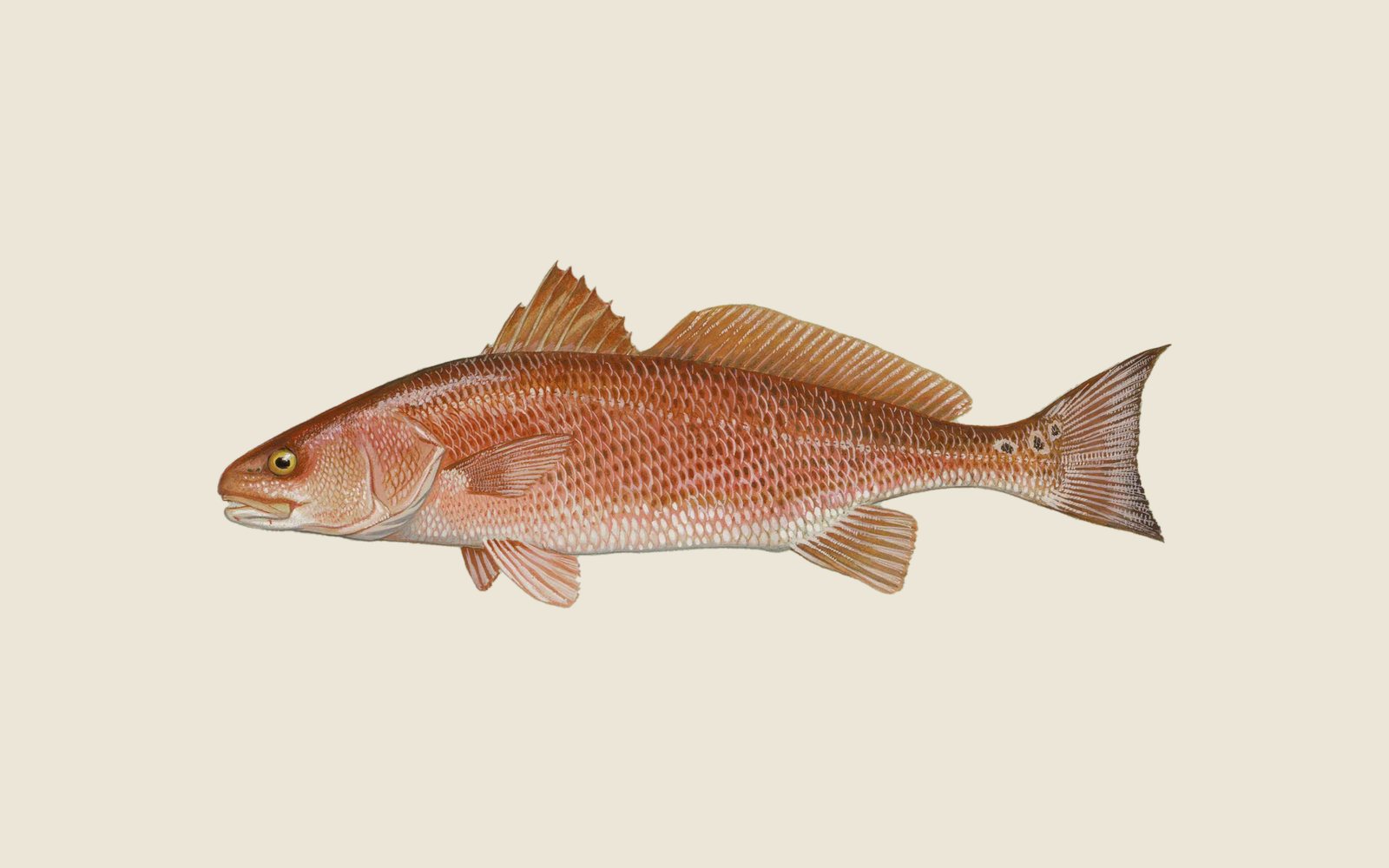
Redfish
Also called Red drum, Channel bass, Puppy drum, Spottail bass
- Typical size
- 22–24 in, 6–8 lb at age 3 (Texas); 10–35 in (Alabama)
- Best months
- Texas: mid-Aug–mid-Oct (spawn and bull run) · Florida: Aug–Dec (spawn) · South Carolina surf: Apr–May and Oct–Nov
- Top baits
- Live shrimp, Finger mullet, Cut mullet, Gold or copper spoons, Soft jigs
- Rig
- Popping cork, or free-shrimped (Texas)
- Line (lb test)
- 8–15 lb on grass flats; 17–25 lb around oysters and pilings (Texas)
Seasons, size and bag limits and licenses vary by state and water. Check your state agency, for example the Texas Parks and Wildlife Department
What are redfish?
Redfish is the angler’s name for the red drum, a Gulf and Atlantic coast inshore fish. North Carolina Marine Fisheries lists channel bass, redfish, puppy drum and spottail bass as other names for the same species.
How to identify a redfish
The tail spot is the giveaway. Texas describes one large black spot at the upper base of the tail, and says multiple spots are common and none is extremely rare. North Carolina adds an inferior mouth, no chin barbels and one or more ocellated tail spots. Florida notes a black drum has chin barbels and no tail spot.
Colour changes with age: silver in young fish and brassy reddish in adults (Alabama), or silver-gray with a copper cast (South Carolina).
Where redfish live
Young reds live in very shallow water. Texas finds them in 1 to 4 feet along bay edges with seagrass, around oyster reefs and along shoreline breaks such as coves, points, jetties, pilings and guts. Alabama says the young hang near grass, jetties and piers, with large fish in the deep parts of estuaries and in passes. Florida says juveniles stay inshore until about 30 inches, or 4 years old.
In winter Florida fish use seagrass, mud and sand, oyster bars and spring-fed creeks, and Texas fish concentrate in rivers and tidal creeks during cold spells. Reds tolerate fresh water (Texas).
Texas says young reds eat crabs, shrimp and worms, and older fish eat larger crabs, shrimp and small fish such as croaker. Florida lists crabs, mullet, pinfish and killifish, and South Carolina says adults eat menhaden, spot, anchovies and blue crab. North Carolina describes reds “tailing” in shallow grass.
When to catch redfish
Spawn and bull red run
Redfish spawn in late summer and fall near passes and inlets. Texas ties its fall “bull redfish run” to the Gulf beaches.
| State | J | F | M | A | M | J | J | A | S | O | N | D |
|---|---|---|---|---|---|---|---|---|---|---|---|---|
| Florida | Not in season: January | Not in season: February | Not in season: March | Not in season: April | Not in season: May | Not in season: June | Not in season: July | In season: August | In season: September | In season: October | In season: November | In season: December |
| Texas | Not in season: January | Not in season: February | Not in season: March | Not in season: April | Not in season: May | Not in season: June | Not in season: July | In season: August | In season: September | In season: October | Not in season: November | Not in season: December |
| North Carolina | Not in season: January | Not in season: February | Not in season: March | Not in season: April | Not in season: May | Not in season: June | Not in season: July | In season: August | In season: September | In season: October | Not in season: November | Not in season: December |
| South Carolina | Not in season: January | Not in season: February | Not in season: March | Not in season: April | Not in season: May | Not in season: June | Not in season: July | In season: August | In season: September | In season: October | In season: November | Not in season: December |
| Alabama | Not in season: January | Not in season: February | Not in season: March | Not in season: April | Not in season: May | Not in season: June | Not in season: July | In season: August | In season: September | In season: October | In season: November | Not in season: December |
Florida says spawning begins as days shorten and the water cools. South Carolina says adults move offshore in late October and November, and that its surf fishing peaks in spring (April to May) and fall (October to November).
Through the year
- Summer: Texas says reds feed in shallows in the early morning and late afternoon and go deeper as the water warms, with tailing schools on flats.
- Fall: Alabama’s Mobile Delta has fall runs of redfish, speckled trout and flounder.
- Winter: Texas finds winter concentrations in rivers and tidal creeks.
How to catch redfish
Live and cut bait
Texas lists live shrimp, small finger mullet, croaker and small live blue crab. Florida fishes live shrimp under a popping cork. For bull reds Texas uses fresh cut mullet, 6 to 8 inch live mullet or blue crab.
Lures
- Spoons: 1/2 and 1/4 ounce gold, copper or silver shallow-running spoons, or a weedless spoon in heavy vegetation (Texas).
- Plugs: floating or shallow fish plugs over grass (Texas), and topwater plugs (Florida).
- Soft plastics: shrimplike plastic worms and jigs (Texas), and soft jigs (Florida).
- Mobile Delta in fall: large crankbaits or plastic grubs, with live-rigged shrimp the favourite (Alabama).
- Surf: heavier spoons and slow-sinking plugs (Texas).
Rigs
Texas fishes a popping cork or free-shrimps. For the surf it names single or double-drop bottom rigs with a grabbing sinker.
Rod and line
Texas lists 17 to 25 pound line around oysters, rocks and pilings and 8 to 15 pound line on grass flats, with a 6.5 to 8 foot medium-action rod for fish under 10 pounds. For surf and pier bull reds it uses several hundred yards of 25 to 40 pound line.
Redfish size and the IGFA record
Texas growth runs 11 inches and 1 pound at one year, 17 to 22 inches and 3.5 pounds at two years, and 22 to 24 inches and 6 to 8 pounds at three years. Alabama gives 10 to 35 inches with large adults up to 40 pounds, and Florida says average maximums are 40 inches and 40 pounds on the Gulf coast and 45 inches and 52 pounds on the Atlantic coast.
The IGFA all-tackle record is 94 pounds 2 ounces (42.69 kg), caught by David Deuel from the surf at Avon, North Carolina, on November 7, 1984, on cut mullet. State records: Florida 52 pounds 5 ounces near Cocoa in 1996, Alabama 45 pounds 4 ounces in August 2007 and Texas 59.5 pounds.
Rules
Limits vary by state. Check the agency where you fish, such as the Texas Parks and Wildlife Department, Florida Fish and Wildlife Conservation Commission or South Carolina DNR.
Frequently asked questions
Are redfish and red drum the same fish?
Yes. North Carolina Marine Fisheries lists channel bass, redfish, puppy drum and spottail bass as names for the red drum.
What is the world record redfish?
IGFA lists 94 pounds 2 ounces (42.69 kg), caught by David Deuel from the surf at Avon, North Carolina, on November 7, 1984, on cut mullet.
How can I tell a redfish from a black drum?
Check the tail and chin. Redfish have one or more black spots near the tail and no chin barbels, and black drum have chin barbels and no tail spot (Florida).
What is the best bait for redfish?
Live shrimp, small finger mullet, croaker and small live blue crab in Texas, and live shrimp under a popping cork in Florida. For bull reds Texas uses fresh cut mullet, 6 to 8 inch live mullet or blue crab.
When do redfish spawn?
Late summer into fall: mid-August to mid-October near Texas passes, and about August to December in Florida passes, inlets and lagoon estuaries.
Sources
- Red drum, Texas Parks and Wildlife Department
- Red drum publication, Texas Parks and Wildlife Department
- Red drum species profile, North Carolina DEQ Division of Marine Fisheries
- Red drum, Florida Fish and Wildlife Conservation Commission
- Red drum quick facts, Florida Fish and Wildlife Conservation Commission
- Red drum, Outdoor Alabama (ADCNR)
- Mobile Delta, Outdoor Alabama (ADCNR)
- Red drum, South Carolina Department of Natural Resources
- Red drum in South Carolina, South Carolina Department of Natural Resources
- Red drum surf fishing report, South Carolina Department of Natural Resources
- Greatest records in sportfishing history, International Game Fish Association
- Red drum, Game Fish Database, International Game Fish Association