

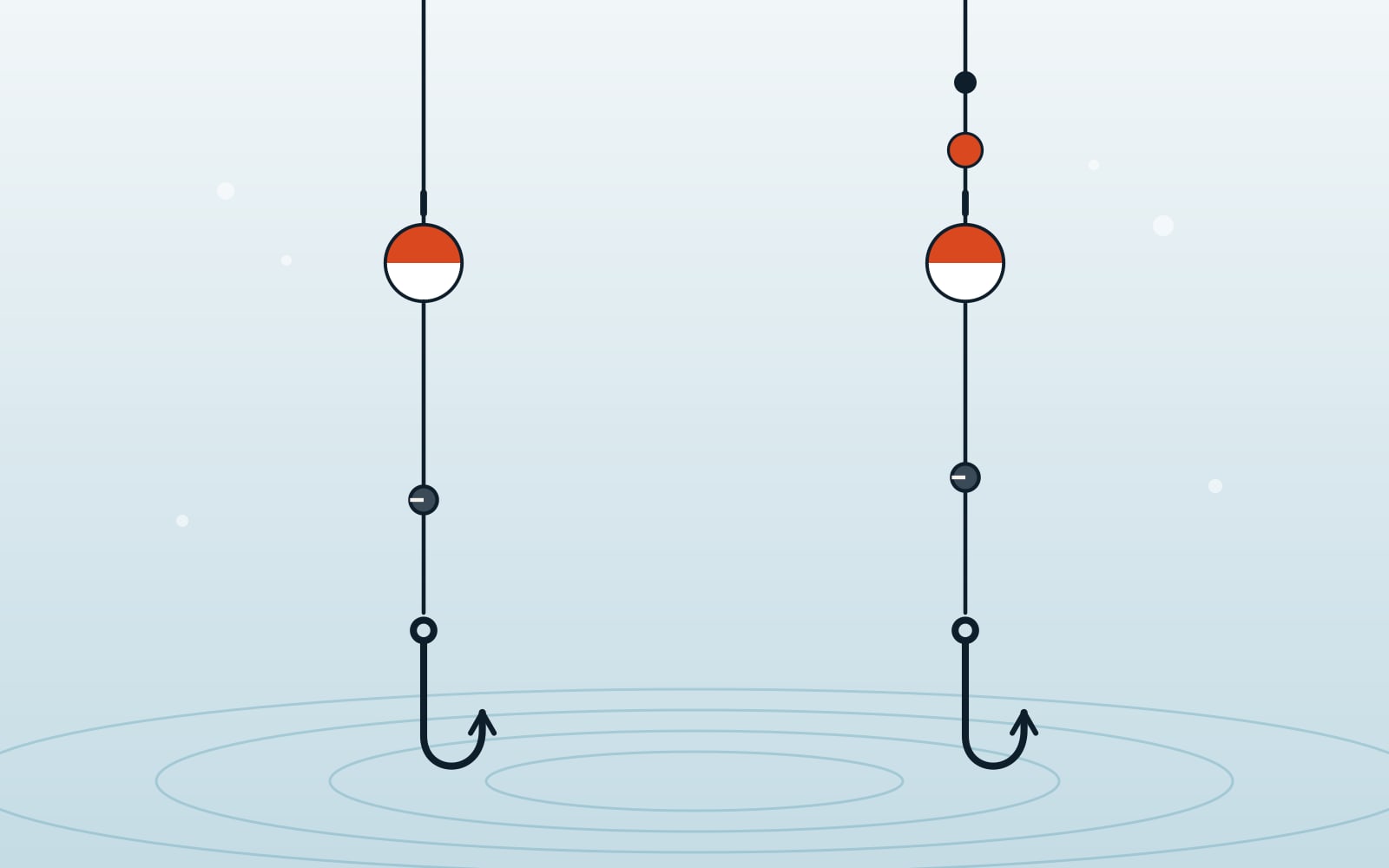
Fixed vs slip bobber
| Fixed bobber | Slip bobber | |
|---|---|---|
| How it attaches | Clips or ties to the line; move it up or down to change depth (OK) | Slides on the line and stops at a stopper knot (OK) |
| Setting depth | Move the bobber; start about 2 ft from the end of the line (SC) | Slide the stopper knot to the depth you want, above the hook (OK) |
| Good for | Beginners: the bobber tells you when a fish takes the bait (NY) | Deeper fish and keeping the lure in the strike zone longer (OK); suspending bait mid-column (OK) |
| Watch for | Can be difficult to use on windy days (NY) | Cuts down on the line needed at the end of the rod and may make casting easier (IN) |
The three jobs of a bobber
New York says a bobber, or float, does three things: it keeps the bait suspended above the bottom, weeds or other cover; it shows when a fish strikes; and it adds weight for casting. Texas and Indiana list the same three. Texas adds that it keeps bait where the fish are biting.
Fixed bobber rig
New York calls this the best rig for beginners, because the bobber tells you when a fish takes the bait. South Carolina’s most popular rig of all is the bobber rig.
- Tie on the hook and add weight. Oregon recommends a size 8 baitholder hook for panfish and yellow perch and larger for bass, walleye and catfish, with the split shot about 6 inches above it.
- Attach the bobber. New York’s spring-loaded bobber: press the top button to expose the bottom hook, then thread the line through the top and bottom hooks and slide it to set depth.
- Set the depth. Adjust until you find where fish are hanging out; New York says they are not always near the bottom or the surface. Hang the hook just above the structure (weeds, logs) or the pond bottom.
- Keep the line tight after casting. That way a fish biting is noticeable (SC).
Slip bobber rig
Oklahoma’s slip cork build: tie a stopper knot onto the line, add a bead, feed the line through a slip bobber, then attach a sinker and hook. Decide how deep you want the bait and slide the stopper knot up the line to that distance above the hook. When cast, the bobber slides up the line to the stopper knot as the bait sinks to the set depth.
Oklahoma says to use a slip cork to reach deeper fish and keep the lure in the strike zone longer, and for suspending bait in the middle of the water column. Indiana says slip bobber rigs cut down on the amount of line needed at the end of the rod and may make it easier to cast. The fishing knots guide covers knots for the line itself. The catfish rigs page uses a slip cork to suspend bait.
Size and balance
Use the smallest bobber you can easily see that holds your bait without submerging (NY). Missouri suggests a small, streamlined bobber balanced with enough split shot beneath that a fish can pull it down without much resistance. Indiana says a properly selected weight creates neutral buoyancy: the bobber should barely float upright, since the harder it is to pull under, the harder it is to hook a fish. Alabama says that if the float is too large, the fish will feel it and may not become hooked. Iowa says when a bobber is used with a jig, fish the jig at least a foot off the bottom.
Reading the bobber
If the bobber starts to go under, a fish is biting (NY). Florida’s float rig is a different layout: a float on the main line above a swivel, adjusted to the height you want above the bait, with optional split shot to weigh the bait down. It suits fish that feed away from the bottom.
Sources
- Knots (I FISH NY lesson plan, PDF), New York State DEC
- Rigging and fishing basics (learn-to-fish guide, PDF), New York State DEC
- Rigging your pole, Missouri Department of Conservation
- Fishing Lines magazine, Florida Fish and Wildlife Conservation Commission
- Favorite warmwater fishing rigs, Oregon Department of Fish and Wildlife
- Fishing tips and videos, Indiana DNR
- Fishing basics handbook (PDF), Texas Parks and Wildlife Department
- Fishing fun in the sun, Oklahoma Department of Wildlife Conservation
- Fishing guide (PDF), South Carolina DNR
- Ice fishing, Iowa DNR
- Crappie, Iowa DNR
- Basic fishing tips (PDF), Alabama Department of Conservation and Natural Resources
- Winter fishing tips, Oklahoma Department of Wildlife Conservation
- Fishing tackle and supplies, Oklahoma Department of Wildlife Conservation
- Crappie angler guide, Oklahoma Department of Wildlife Conservation