

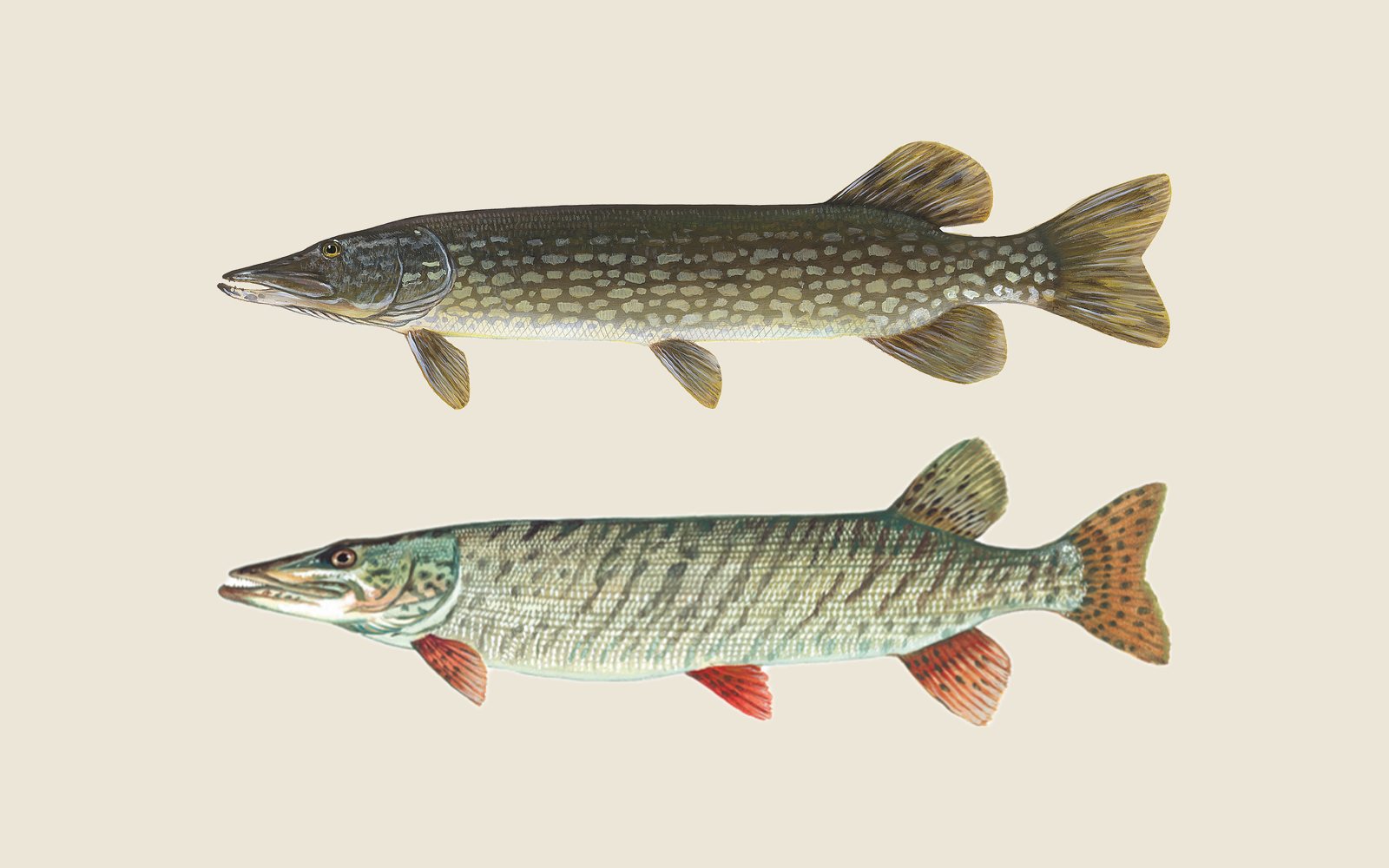
Muskie vs pike: the marks that separate them
No single mark settles every fish, and the agencies do not agree on the pore counts. Read the table, then check three or four marks on the fish in hand.
| Mark | Northern pike | Muskellunge (muskie) | Tiger muskie |
|---|---|---|---|
| Markings | Bluish green with light bean-shaped spots in horizontal rows (Iowa, Wisconsin); light spots on a dark background (Indiana) | Variable dark vertical bars on olive or dark gray (Iowa); dark spots or bars on a light background (Indiana) | Dark vertical bars and irregular spots on olive to dark gray (Iowa); dark stripes on a lighter background (USGS) |
| Pores under the jaw, per side | 5 or fewer (Iowa, Indiana, USGS); 5 to 7 (Wisconsin); never more than 10 (Iowa fish profile) | 6 or more (Iowa); 6 to 9 (Indiana, Missouri, USGS, Wisconsin) | 5 to 8 (Indiana); 5 to 6 (USGS); 5 to 7 (Wisconsin) |
| Cheek and gill cover | Cheek fully scaled; Wisconsin adds the upper half of the gill cover | Scales on the upper half of the cheek and gill cover only (Iowa, Missouri) | Not given |
| Tail lobes | Rounded (Indiana, Iowa) | Pointed (Indiana, Iowa) | Rounded (Iowa) |
| Size | About 4 ft and 40 lb or more (Indiana); common catches 18 to 20 in and about 2 lb (Wisconsin) | Up to 5 ft and 70 lb (Indiana); maximum length 183 cm (USGS) | Grows faster and larger than either parent (USGS) |
| IGFA all-tackle record | 55 lb 1 oz (25 kg) | 67 lb 8 oz (30.61 kg) | 51 lb 3 oz (23.21 kg) |
Why pore counts alone mislead
Muskie and pike both have a row of pores along each underside of the lower jaw. Iowa, Indiana and USGS say pike have five or fewer and muskie six or more. Wisconsin gives 5 to 7 for pike and 6 to 9 for muskie, so the ranges overlap at 6 and 7, and Iowa’s fish profile says pike never have more than 10. Tiger muskie fall at 5 to 8 in Indiana, 5 to 6 in USGS and 5 to 7 in Wisconsin. Counts of 6 and 7 fall in both ranges, so lean on the other marks.
A quick checklist
- Look at the colour pattern. USGS says coloration usually distinguishes muskie from pike. Light spots on dark means pike, and dark bars on light means muskie.
- Check the cheek. A fully scaled cheek is pike (Iowa, Wisconsin). A cheek scaled on the upper half only is muskie (Iowa, Missouri).
- Look at the tail. Pointed lobes are muskie and rounded lobes are pike (Iowa, Indiana). A tiger muskie also has rounded lobes (Iowa), which is another reason to combine marks.
- Count the pores. Count along each side of the lower jaw and use the ranges above as a tiebreaker.
What is a tiger muskie?
A tiger muskie is a hybrid between northern pike and muskellunge. Wisconsin describes the cross as a male pike with a female muskellunge. USGS says it has 5 to 6 pores and dark stripes on a lighter background, and grows faster and larger than its parents. Iowa says a tiger muskie counts as a muskie for length, bag and possession limits, so identify it before you keep it.
Where and when they live and spawn
Indiana says both fish prefer clear, vegetated, slow water and are ambush predators that eat mainly fish. Wisconsin describes pike as living in shallow, cool, weedy lakes.
- Pike spawn first: at the ice break-up in late March and early April (Wisconsin), starting at 35°F after ice-out in mid-March in Iowa, or around 48°F in Indiana. Iowa says they use flooded marshes.
- Muskie follow: Iowa says several weeks later, in tributaries and lake channels. Indiana says at or above 50°F, in April to early May.
- Cold water: Wisconsin says pike are most active in cold water and easier to catch in winter than summer.
How hard each one is to catch
Wisconsin DNR says northern pike are far less wary than muskellunge: on average it takes about eight hours of fishing to hook a northern, while anglers must log nearly 100 hours on the water to get a glimpse of a muskellunge. For lure choices, see the best pike lures.
Size and records
Indiana says muskie reach up to 5 feet and 70 pounds, and pike about 4 feet and 40 pounds or more. Virginia says pike can exceed 50 inches. Wisconsin says common pike catches are 18 to 20 inches and about 2 pounds.
IGFA lists 67 pounds 8 ounces (30.61 kg) for muskellunge, 55 pounds 1 ounce (25 kg) for northern pike and 51 pounds 3 ounces (23.21 kg) for tiger muskellunge. The pike record was caught by Lothar Louis at Lake of Grefeern, Germany, on October 16, 1986, on a spoon. Iowa’s state pike record is 25.31 pounds and 45 inches from West Okoboji in 1977.
Rules
Limits differ between the two fish. Iowa lists a 40 inch minimum for muskie and no length requirement for pike, and says to check current rules. Check the agency where you fish, such as Iowa DNR or the Wisconsin DNR.
Frequently asked questions
What is the easiest way to tell a muskie from a northern pike?
Look at the markings and the cheek. Pike have light bean-shaped spots on a dark body and a fully scaled cheek. Muskie have dark bars or spots on a lighter body and scales only on the upper half of the cheek (Iowa, Wisconsin, Missouri).
How many pores does a muskie have under the jaw?
Six to nine per side according to Indiana, Missouri, USGS and Wisconsin. Pike have five or fewer in Iowa, Indiana and USGS data, but Wisconsin lists 5 to 7, so the counts overlap and you should use other marks too.
What is a tiger muskie?
A hybrid of northern pike and muskellunge. Iowa says it counts as a muskie for length, bag and possession limits, and it has dark bars and irregular spots. Indiana counts 5 to 8 pores per side.
Which grows bigger, muskie or pike?
Muskie. Indiana gives up to 5 feet and 70 pounds for muskie and about 4 feet and 40 pounds or more for pike. IGFA lists 67 pounds 8 ounces for muskellunge and 55 pounds 1 ounce for northern pike.
Which is easier to catch?
Pike. Wisconsin DNR says it takes about 8 hours of fishing to hook a northern pike and nearly 100 hours to see a muskellunge.
Sources
- Know your catch: how to ID northern pike and muskies, Iowa DNR
- Pikes of Indiana, Indiana DNR
- Northern pike, Wisconsin DNR
- Muskellunge (Esox masquinongy) fact sheet, USGS Nonindigenous Aquatic Species
- Muskellunge, Missouri Department of Conservation
- Northern pike, Iowa DNR
- Muskellunge, Iowa DNR
- Northern pike state record, Iowa DNR
- Northern pike, Virginia Department of Wildlife Resources
- Muskellunge, Game Fish Database, International Game Fish Association
- Northern pike, Game Fish Database, International Game Fish Association
- Tiger muskellunge, Game Fish Database, International Game Fish Association
- Greatest records in sportfishing history, International Game Fish Association